AI vs offshore talent is the wrong debate when the real issue is work design.
Most lean teams do not need to choose between automation and people. They need to decide which work belongs with AI, which work needs offshore ownership, and which work should stay close to the founder or core team.
AI can help a team move faster. Offshore talent can help a team carry more. Your core team should stay focused on work that needs judgment, relationships, and strategy.
The problem starts when these lines blur.
A founder uses AI to speed up admin, but still ends up reviewing everything. A business hires offshore support, but hands over broken processes. A team keeps sensitive decisions in-house, but still lets senior people carry repetitive coordination work.
A stronger workforce model uses all three layers with intent:
- AI for repeatable, rules-based, and first-pass work.
- Offshore talent for consistent execution, ownership, coordination, and follow-through.
- Core team members for judgment, leadership, client relationships, and strategic decisions.
That is where the capacity gain sits. Not in replacing people with tools, and not in hiring offshore for every problem, but in matching the work to the right layer.
AI and Offshore Talent Should Not Be an Either-Or Decision
Businesses often ask whether they should use AI or offshore talent. The better question is what type of work they are trying to move.
Some work should be automated. Some work needs a trained person to own it. Some work should stay with the founder, CEO, or senior team because the cost of getting it wrong is too high.
Why the strongest workforce model uses both
AI and offshore talent solve different problems.
AI helps reduce manual effort. It can draft, summarise, sort, classify, and create first-pass outputs quickly. Offshore talent helps with ownership. A person can manage a workflow, follow up stakeholders, check quality, escalate exceptions, and close the loop.
Used together, they create a more useful operating model. AI speeds up the work. Offshore talent gives the work accountability. The core team decides what matters.
PeoplePartners has also covered this shift in its article on AI and offshore teams for business growth, which explains why AI works best when skilled humans direct, check, and apply its outputs.
Where automation helps
Automation helps when the work is predictable and repeatable.
This includes:
- Drafting first-pass content
- Summarising meeting notes
- Sorting data into categories
- Creating templates
- Formatting documents
- Extracting information
- Producing starting points for review
AI is useful when the task has clear inputs and a clear review process. It is less useful when the work needs nuance, relationship context, or a decision the business must stand behind.
Where human judgment still matters
Human judgment matters when the work involves risk, interpretation, relationships, or trade-offs.
Harvard Business School has noted that AI still cannot reliably separate strong ideas from weak ones or guide long-term business strategy on its own. Human experience and judgment remain central to effective decision-making.
That matters for lean teams. AI can create the draft, but a person still needs to decide whether the draft is accurate, useful, on-brand, and safe to send.
The Real Question: What Kind of Work Are You Trying to Move?
Before choosing AI, offshore talent, or in-house ownership, define the work.
Do not start with the tool. Start with the task.
Repetitive work
Repetitive work happens often and follows a similar pattern each time.
Examples include:
- Weekly reports
- File naming
- Data entry
- Inbox sorting
- CRM updates
- Meeting note summaries
This work is usually a strong candidate for AI support, offshore delegation, or both.
Rules-based work
Rules-based work follows clear instructions.
For example:
- Categorise leads by source
- Flag overdue invoices
- Format proposals using a template
- Route support tickets by issue type
- Send follow-ups after a set number of days
AI can support this type of work well when the rules are clear. Offshore talent can own the process and deal with anything that falls outside the rules.
Context-heavy work
Context-heavy work depends on knowing the customer, the team, the history, or the reason behind a decision.
Examples include:
- Reviewing a sensitive client email
- Deciding which lead needs senior follow-up
- Interpreting unusual reporting results
- Choosing the right next step on a delayed project
This work should not be handed fully to AI. It may be supported by offshore talent, but the role needs context and escalation rules.
Relationship-based work
Relationship-based work depends on trust, tone, and timing.
This includes:
- Client calls
- Sensitive supplier conversations
- Team feedback
- Negotiation
- Strategic partnerships
Offshore talent may support coordination, preparation, notes, and follow-ups. The relationship owner should remain clear.
Decision-led work
Decision-led work affects direction, risk, positioning, cost, or reputation.
This includes:
- Pricing decisions
- Hiring decisions
- Brand calls
- Commercial trade-offs
- Client escalation decisions
- Strategic priorities
Keep this work with the founder, leadership team, or senior owner. AI and offshore support can prepare the information, but they should not own the decision.
What to Automate With AI

AI works best as a speed layer. It helps people get to a first version faster, especially when the task is repeatable and the output can be reviewed.
Drafting first-pass content or documents
AI can help create:
- Email drafts
- Blog outlines
- Meeting agendas
- SOP starting points
- Proposal sections
- Internal updates
The first pass is not the final version. A person still needs to check tone, accuracy, context, and whether the output matches the business standard.
Summarising information
AI can summarise long notes, call transcripts, reports, and documents.
This is useful for busy teams, but summaries should still be checked. AI can miss the nuance of a decision, downplay a risk, or make a detail sound more certain than it is.
Sorting and categorising data
AI can help classify information quickly.
For example:
- Grouping customer feedback
- Sorting tickets by topic
- Categorising leads
- Flagging repeated issues
- Organising research notes
This is useful when the categories are clear. If the categories are vague, the output will be vague too.
Creating templates and starting points
AI is useful for building a base structure.
It can help create:
- Email templates
- Checklist drafts
- Reporting formats
- Interview questions
- Task instructions
- Draft process notes
The value is speed. The risk is assuming a template is automatically fit for your business.
Speeding up repetitive workflows
AI can reduce the time spent on repetitive work, especially when paired with clear review steps.
The strongest use cases are not usually flashy. They are practical. A weekly report takes less time. A meeting summary gets drafted faster. A first-pass email is ready for review. A spreadsheet gets cleaned before a person checks exceptions.
What to Delegate to Offshore Talent
Offshore talent works best where the business needs a person to own recurring work, manage follow-through, and keep systems moving.
Admin coordination
Offshore admin support can manage:
- Scheduling
- Inbox triage
- Document filing
- Internal follow-ups
- Meeting preparation
- Travel coordination
- Routine communication
This removes low-value coordination work from founders and senior team members.
Operations support
Operations support can include:
- Workflow tracking
- Process documentation
- Supplier coordination
- Reporting preparation
- Internal task follow-up
- Handover support
This works well when the role has clear ownership, tools, and escalation rules.
CRM and database management
CRM and database support can keep business information accurate.
Tasks may include:
- Updating records
- Cleaning duplicate data
- Adding notes
- Creating reports
- Checking missing fields
- Preparing lead lists
This is a strong offshore role when data standards are defined.
Finance administration
Finance admin support can help with:
- Invoice preparation
- Receipt management
- Data entry
- Reconciliation support
- Accounts follow-up
- Document organisation
The business should keep approval rules clear. Anything involving payment decisions, unusual discrepancies, or commercial risk should escalate to the right person.
Marketing execution
Offshore marketing support can manage practical execution.
This may include:
- Uploading blogs
- Scheduling posts
- Formatting newsletters
- Updating website content
- Preparing reports
- Organising assets
- Building campaign task lists
Strategy and brand-sensitive decisions should stay with the core team, but execution can often be delegated with the right brief.
Customer or client support tasks
Offshore support can help manage recurring client or customer tasks.
This includes:
- Ticket triage
- Standard responses
- Follow-up reminders
- Knowledge base updates
- Status updates
- Support reporting
Sensitive or high-risk conversations still need clear escalation rules.
What to Keep With Your Core Team
Some work should not be moved offshore or automated without careful control.
The question is not whether your team trusts AI or offshore staff. The question is whether the work requires judgment that belongs close to the business.
Strategic decisions
Client relationships that need senior judgment
Some relationships carry commercial, reputational, or long-term value.
Offshore support can prepare notes, update records, schedule follow-ups, and draft summaries. Senior relationship owners should keep the decisions and sensitive conversations.
Brand-sensitive decisions
Brand voice, positioning, and reputation need careful handling.
AI can draft options. Offshore marketing support can prepare execution. The final decision should stay with someone who knows what the brand should sound like and what it should avoid.
Complex problem-solving
Complex problems rarely have a clean input and output.
They need interpretation, trade-offs, and experience. Keep these with your core team, with AI and offshore support providing research, reporting, or coordination.
Work that needs deep business context
Some work depends on knowing why the business operates a certain way.
This includes decisions shaped by past client issues, founder preferences, market positioning, internal politics, or commercial sensitivity. That kind of context is hard to automate and should not be delegated loosely.
Where AI Alone Falls Short
AI is useful. It is not an operating model by itself.
A tool can reduce effort, but it cannot own accountability.
AI does not own accountability
AI can produce output. It does not take responsibility for whether the output is right, useful, or appropriate.
Someone still needs to check the work, apply context, and decide what happens next.
AI does not manage exceptions well without oversight
AI works best when patterns are clear. Exceptions are where people matter.
A client issue, unusual invoice, unclear instruction, missing field, or sensitive internal update may not fit the standard path. A person needs to interpret the exception and escalate it properly.
AI cannot replace role clarity
If a process is messy, AI can make the mess move faster.
Role clarity still matters. The business needs to know who owns the task, who reviews the output, who approves decisions, and what happens when the tool gets it wrong.
AI outputs still need review, context, and judgment
A 2026 HBR article on judgment in the AI era argues that productivity gains from AI depend partly on whether people can tell if AI-generated work is any good. That is a real operating issue for lean teams.
If no one has the context to review the output properly, AI can create confidence without quality.
Where Offshore Hiring Alone Falls Short
Offshore hiring also has limits.
A person can do the work, but they cannot fix every structural issue around the work.
A person cannot fix a broken process alone
Hiring offshore support into a broken process usually creates frustration.
The offshore hire may work hard, but if the workflow has no owner, no standards, and no escalation rules, performance will still suffer. This is why PeoplePartners starts with the task audit before recruitment.
Repetitive work should not always become headcount
Some repetitive work should be automated before it becomes a role.
For example, if AI can draft first-pass summaries or organise data before review, the offshore hire can spend more time on quality control, execution, and follow-up.
Headcount should solve ownership problems, not absorb avoidable manual work.
Poor systems create poor offshore outcomes
Offshore hiring works best when the person has the tools, access, instructions, and context they need.
PeoplePartners’ offshore staffing guide explains that offshore staff are most effective when they work as part of the client’s internal team rather than as a disconnected outsourced service.
How to Decide: Automate, Offshore, or Keep In-House
Use AI when the work is repeatable and rules-based
Use AI when the task has:
- Clear inputs
- Clear rules
- Low risk
- A repeatable format
- A review step
Examples include summaries, first drafts, templates, categorisation, and data clean-up.
Use offshore talent when the work needs consistency and ownership
Use offshore talent when the work needs a person to:
- Manage a recurring workflow
- Coordinate across people
- Check quality
- Follow up
- Update systems
- Escalate exceptions
- Make low-risk decisions within clear rules
This is where offshore roles can remove real pressure from founders and lean teams.
Keep work in-house when it needs strategic judgment
Keep the work in-house when it involves:
- Business direction
- High-value client relationships
- Sensitive brand decisions
- Complex trade-offs
- Commercial risk
- Deep internal context
AI and offshore support can prepare information. The core team should still decide.
Combine AI and offshore talent when speed and accountability both matter
This is often the strongest model.
For example:
- AI drafts the meeting summary.
- Offshore talent checks the summary, updates CRM, assigns follow-ups, and flags risks.
- The core team reviews anything that needs judgment.
That model gives the business speed without losing accountability.
What a Hybrid Workforce Model Can Look Like

A hybrid workforce model does not need to be complicated. It needs clean ownership.
AI creates the first pass
AI can create drafts, summaries, checklists, reports, templates, and categorised data.
This reduces the time spent starting from scratch.
Offshore talent manages execution
The offshore team member can turn the first pass into completed work.
They can:
- Review the AI output
- Check details against source material
- Update systems
- Follow up stakeholders
- Prepare the final version
- Escalate anything unclear
The core team reviews, decides, and leads
The core team should stay focused on judgment.
That includes reviewing work that affects strategy, clients, brand, pricing, risk, or reputation.
The business gains capacity without handing over control
How PeoplePartners Helps Build the Right Mix
PeoplePartners starts with the work, not the job title.
That distinction matters. A business may think it needs a VA, an admin assistant, a marketing coordinator, or an operations support person. The task audit may show that the better answer is a hybrid mix: automate the first pass, offshore the recurring execution, and keep judgment with the core team.
Start with the task audit
The task audit identifies where time is going and which tasks are sitting with the wrong people.
This includes low-value work that is draining senior capacity, repeatable work that could be supported by AI, and recurring workflows that need a dedicated owner.
Identify what should be automated, delegated, or retained
Each task should be sorted into one of three groups:
- Automate: repeatable, rules-based, low-risk work.
- Delegate offshore: recurring work that needs ownership, consistency, and follow-through.
- Keep in-house: strategic, sensitive, high-judgment work.
This gives the business a practical workforce map before hiring starts.
Design offshore roles around outcomes
PeoplePartners designs offshore roles around the work the business needs removed, not around a generic task list.
That supports better role-fit hiring. It also helps avoid using offshore talent as a catch-all for every task the local team does not want to do.
Keep business owners in control of the final hiring decision
PeoplePartners uses Zero Bench Recruiting, which means candidates are sourced to the client’s actual role requirements rather than assigned from a generic bench.
Business owners stay involved in the final hiring decision. PeoplePartners supports the role design, recruitment process, onboarding structure, and ongoing employment layer, but the client chooses who joins the team.
Build a Smarter Workforce Mix
AI vs offshore talent should not be a fight between tools and people.
Use AI where speed matters and the rules are clear. Use offshore talent where work needs ownership and follow-through. Keep strategic, sensitive, and relationship-led work close to your core team.
That is how lean teams rebuild capacity without losing control.
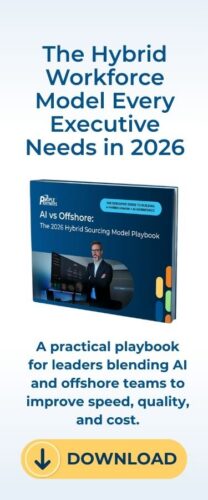
Not sure what to automate and what to offshore? Download the AI vs Offshore: Hybrid Sourcing Playbook.
It will help you sort work into the right layer: automate, delegate, or keep human.
If you want help applying this to your own team structure, contact PeoplePartners. We can help you identify which tasks should be automated, which roles can be offshored, and where your core team should stay focused.
Frequently Asked Questions (FAQs)
What is the difference between AI and offshore talent?
Automate work when it is repetitive, predictable, and rules-based. Delegate offshore when the work needs a person to manage exceptions, communicate with others, maintain quality, or take responsibility for completion.
AI can reduce manual effort, but it does not replace accountability, context, relationship management, or judgment. Many teams get better results when AI supports offshore staff rather than replacing them.
Keep work in-house when it involves strategy, sensitive client relationships, senior decision-making, complex problem-solving, or brand decisions that need deep business context.
AI can create drafts, summaries, templates, and workflow shortcuts. Offshore talent can review outputs, manage execution, update systems, coordinate next steps, and escalate anything that needs business judgment.