RTO assessment admin rarely looks like the biggest problem at first.
It starts with a few missing documents. A trainer follows up a student because they know the learner. Then they check an evidence file because they understand the assessment requirements. Then they upload records, chase signatures, update the LMS, prepare reports, and answer internal questions about where everything sits.
None of those tasks are unusual inside a busy RTO. The issue is where they sit.
When trainers carry too much assessment admin, delivery quality starts to compete with documentation work. Learner support loses time. Assessment turnaround slows. Compliance managers inherit messy records later, often when audit pressure is already building.
This is not always a staffing problem. Many RTOs do not need to simply add another trainer. They need to separate trainer work from support work, then build admin capacity around the assessment workflow.
Trainer Overload Is Usually Bigger Than a Staffing Problem
Why adding another trainer may not fix the issue
If trainers are overloaded because they are carrying admin, another trainer may only spread the same admin problem across more people.
The RTO may still have:
- Incomplete student files
- Late evidence follow-ups
- Unclear document ownership
- Manual record checks
- LMS or CRM updates sitting with trainers
- Reporting that depends on too few people
A new trainer can increase delivery capacity. They cannot automatically fix admin workflows that have no clear owner.
How admin work quietly eats into delivery quality
Assessment admin can look harmless because each task is small.
A file check takes a few minutes. A student follow-up takes a few minutes. An LMS update takes a few minutes. A missing document chase takes a few minutes.
Then the trainer’s day disappears in fragments.
The cost is not only time. It is attention. Trainers need space to support learners, prepare delivery, assess work properly, and respond to individual learning needs. When admin eats into that space, the quality pressure becomes real.
Why role design matters in RTO operations
RTO operations need clean role design because training, assessment, administration, and compliance are tightly connected.
If no one owns routine assessment admin, it drifts toward the person with the most process knowledge. That is often the trainer.
Good role design defines:
- What trainers own
- What admin support owns
- What compliance managers review
- What gets escalated
- What evidence needs checking
- Where records are stored
- When follow-ups happen
The goal is not to remove trainers from assessment responsibility. The goal is to stop using trainer expertise for work that does not need a trainer.
What Assessment Admin Looks Like Inside a Busy RTO
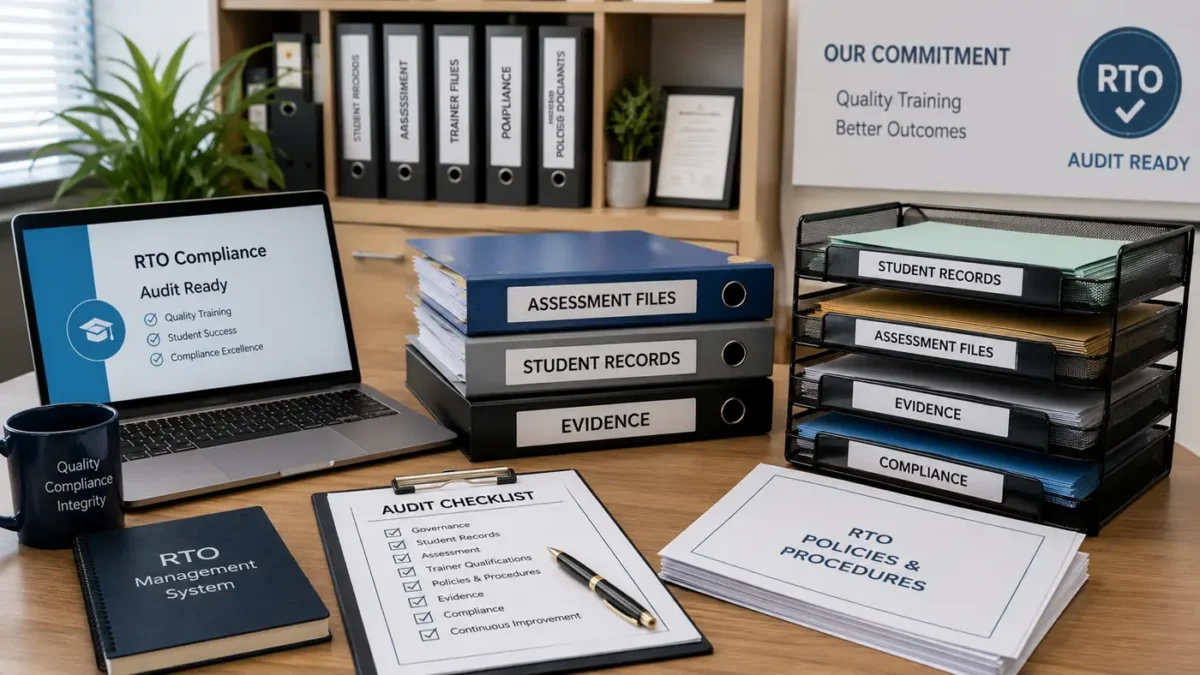
Chasing incomplete student files
Incomplete student files create friction for trainers, compliance teams, and administrators.
Common examples include:
- Missing IDs
- Unsigned forms
- Incomplete enrolment details
- Missing workplace evidence
- Incomplete assessment submissions
- Unreturned declarations
- Gaps in supporting documentation
When these are not chased early, they become harder to clean up later.
Checking evidence requirements
Assessment evidence needs to be complete, organised, and easy to locate.
ASQA’s assessment practice guidance explains that assessors make assessment judgments based on rules of evidence, including validity, sufficiency, authenticity, and currency. That does not mean admin support should make assessment judgments. It does mean evidence handling needs a clear process so trainers and assessors are not wasting time trying to locate or organise records.
Uploading and organising assessment records
Busy RTOs rely on LMS, SMS, CRM, cloud storage, and internal trackers.
Assessment admin may include:
- Uploading files
- Naming documents correctly
- Checking folder structures
- Updating completion status
- Saving evidence in the right location
- Matching documents to student records
- Flagging missing or incorrectly filed records
This work must be consistent. Inconsistent filing becomes a problem when someone needs to find evidence quickly.
Following up missing documentation
Follow-up is one of the most common admin drains inside an RTO.
The task itself is simple. The volume creates pressure.
Admin support can help track who has been contacted, when reminders were sent, what is still missing, and when the issue needs escalatio
Preparing reports and audit-related records
RTO teams often need regular visibility over file status, assessment progress, outstanding evidence, and documentation gaps.
The 2025 Standards for RTOs took effect on 1 July 2025 and define the requirements RTOs are expected to meet and the outcomes they are expected to deliver. RTOs need organised records and clear accountability to support those outcomes.
Why Trainers End Up Carrying Too Much Admin
Small teams grow without redesigning roles
In a small RTO, people often wear multiple hats. That can work for a while.
As enrolments grow, the same habits continue. Trainers keep following up files because they always have. Compliance managers keep answering process questions because they know the standards. Operations managers keep manually checking reports because no support layer has been built.
The team grows, but the role design stays old.
Compliance requirements create more documentation pressure
RTOs operate in a documentation-heavy environment.
Training and assessment must be supported by the right evidence, records, and processes. ASQA’s practice guides are designed to support provider understanding of expectations under the revised Standards for RTOs, which came into full regulatory effect on 1 July 2025.
That context matters. When documentation pressure rises, admin work needs structure. Otherwise, it lands with whoever can keep the process moving.
Admin tasks get attached to whoever understands the process
Trainers understand the learner journey. They understand assessment requirements. They know which evidence matters and why a missing file can create problems later.
That knowledge makes them useful. It also makes them vulnerable to becoming the default admin owner.
A better structure lets trainers define what matters while admin support handles routine collection, organisation, tracking, and follow-up.
Trainers become the default problem-solvers
When a student file is incomplete, someone asks the trainer. When evidence is missing, someone asks the trainer. When a report does not match reality, someone asks the trainer.
Over time, the trainer becomes the system.
That is risky. A strong RTO should not depend on one person’s memory or inbox to know whether files are complete.
How Admin Overload Affects Training Quality
Admin overload affects training quality because it competes for trainer time, focus, and energy.
The impact is not always immediate. It builds quietly.
Less time for learner support
Learners need trainers who have time to teach, answer questions, provide feedback, and support progress.
When trainers spend too much time chasing documentation, learner support gets squeezed into whatever time is left.
Slower assessment turnaround
Assessment turnaround slows when trainers are juggling files, follow-ups, uploads, and delivery.
Students wait longer. Trainers feel more pressure. Operations teams have less visibility. Compliance teams may only see the issue once records are already behind.
More risk of missed details
Admin overload increases the risk of missed details.
Examples include:
- A document saved in the wrong place
- A missing signature
- An untracked follow-up
- An incomplete evidence file
- A report that does not reflect current status
- A student record that has not been updated
Small misses can create larger clean-up work later.
Higher trainer fatigue
Trainer fatigue is not only caused by teaching load. It is also caused by constant task-switching.
A trainer who moves between delivery, assessment, student support, admin follow-up, LMS updates, and compliance questions is carrying too many work modes in one day.
Reduced capacity for growth
RTOs that want to grow need delivery capacity and operating capacity.
If every new student adds more admin pressure to the trainer group, growth becomes harder to absorb. The RTO may win more enrolments but lose control of the back-end work that supports quality delivery.
How Admin Overload Affects Audit Readiness
Audit readiness is not something to clean up at the end.
It is built through everyday habits: file checks, evidence tracking, record organisation, follow-up discipline, and clear ownership.
Records become harder to locate
Disorganised records slow everyone down.
If assessment files are stored inconsistently, compliance teams may spend too much time searching instead of reviewing.
Follow-ups happen too late
Late follow-ups create avoidable pressure.
A missing document that could have been chased early becomes a bigger problem when the student has moved on, the trainer is busy, or the audit timeline is close.
Evidence gaps become harder to spot
Evidence gaps are easier to fix when they are spotted early.
If trainers are overloaded and admin checks are inconsistent, gaps may stay hidden until a compliance manager reviews the file.
Compliance managers spend more time cleaning up issue
Compliance managers should not be the clean-up crew for every admin breakdown.
Their work should focus on oversight, review, improvement, and risk management. When routine admin is weak, compliance managers spend too much time locating records, chasing missing files, and reconstructing what should have been organised earlier.
5 Admin Bottlenecks Quietly Slowing Your RTO
RTO admin bottlenecks often hide inside normal operations.
Here are five to look for.
Manual student file checks
Manual file checks are not always avoidable, but they need a clear process.
If every trainer checks files differently, the RTO gets inconsistent records.
Repetitive assessment follow-up
Repeated follow-up should not depend on trainer memory.
A simple tracking process can show:
- Who is missing evidence
- What has been requested
- When the last reminder was sent
- Who needs escalation
- What is ready for review
Disorganised evidence tracking
Evidence tracking should be visible and current.
When it lives across inboxes, spreadsheets, LMS notes, and personal reminders, the RTO loses control of the workflow.
Trainer-led admin escalation
Trainers should not be the escalation point for every admin issue.
They should provide assessment expertise where needed, but routine admin escalation should sit with a support role or operations owner.
Reporting that depends on too few people
Reporting becomes fragile when only one or two people know how to prepare it.
RTOs need reporting support that is documented, repeatable, and not dependent on one overloaded staff member.
What RTOs Should Take Off Trainers’ Plates First
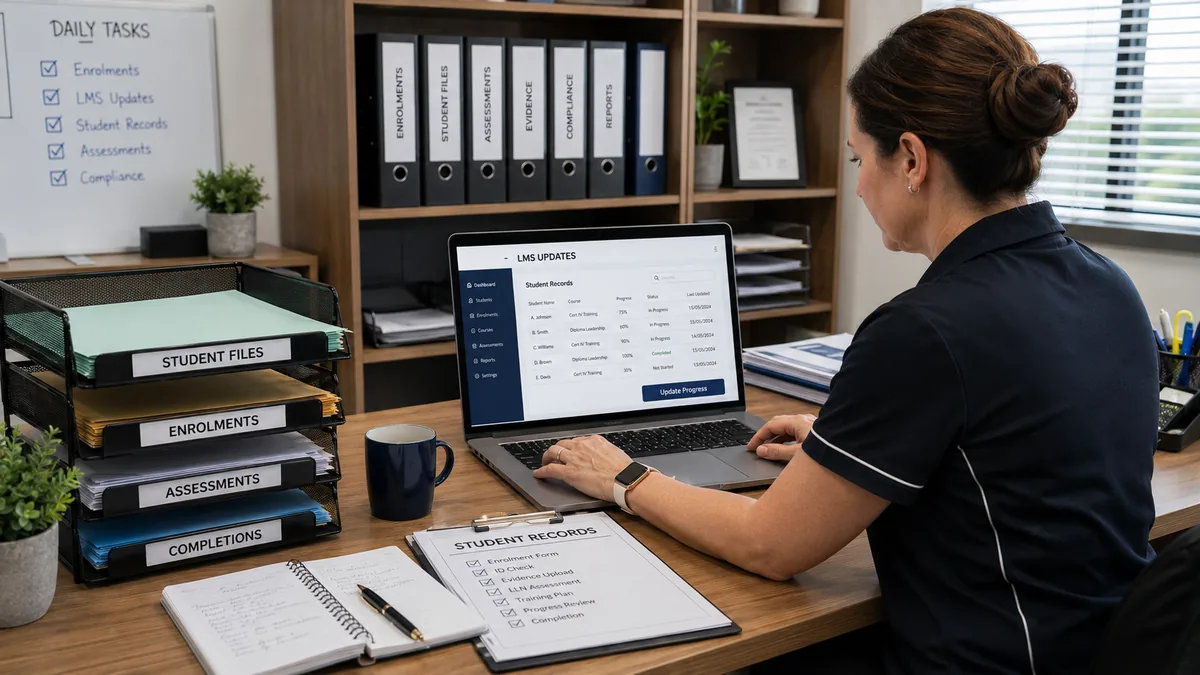
RTOs do not need to remove every admin task at once.
Start with the tasks that are repetitive, process-driven, and do not require trainer judgment.
Routine document collection
Document collection can often move to admin support when requirements are clear.
This includes chasing forms, IDs, declarations, workplace evidence, and other routine documents.
Assessment file organisation
Trainers should not spend hours naming, saving, and organising files.
Admin support can help maintain file structures, upload documents, check naming conventions, and flag missing items for review.
Student follow-up reminders
Student follow-ups can be tracked and sent by a support role using approved templates and escalation rules.
The trainer can stay involved where the follow-up requires learning support or assessment expertise.
Admin reporting support
LMS and CRM data maintenance
LMS and CRM maintenance can drain trainer time fast.
Tasks may include:
- Updating student status
- Checking completion fields
- Uploading documents
- Correcting data entry issues
- Maintaining contact records
- Flagging missing information
These tasks need accuracy and consistency. They do not always need a trainer.
Where Offshore Support Can Help RTO Teams
Offshore support can help RTOs build operating capacity when the role is clearly scoped and properly supervised.
It should not replace trainer judgment. It should support the admin layer around training and assessment.
Admin support roles for assessment workflows
An offshore admin support role can help with:
- Document collection
- File organisation
- Student follow-ups
- LMS updates
- CRM maintenance
- Evidence tracking
- Report preparation
This gives trainers more time for delivery and assessment decisions.
Operations support for training delivery teams
Offshore operations support can help coordinate the moving parts around training delivery.
This may include calendar coordination, resource tracking, internal follow-ups, reporting support, and workflow monitoring.
Documentation support before audit pressure builds
The best time to improve documentation support is before audit pressure builds.
That means setting up repeatable admin workflows, clear file structures, and regular checks before the team is forced into clean-up mode.
Why offshore support should sit inside a clear role structure
Offshore support works when the role has clear boundaries.
The person should know:
- What they own
- What they check
- What they do not decide
- What gets escalated
- Who reviews their work
- Which systems they use
- Which standards they follow
This protects the RTO and helps the offshore hire perform well.
How PeoplePartners Supports RTO Role Design
PeoplePartners supports RTOs by starting with role structure before recruitment.
That matters because RTO support roles need more than generic admin capability. They need to fit the operating environment.
Start by identifying where admin work is sitting
The first step is to identify where admin work currently sits.
Often, it is spread across trainers, compliance staff, operations managers, and directors. A task audit helps show which work is sitting with the wrong person.
Separate trainer work from support work
Trainer work should focus on training delivery, learner support, assessment decisions, feedback, and expertise.
Support work can include routine collection, organisation, data maintenance, follow-up tracking, and reporting preparation.
This separation gives RTO leaders a cleaner structure.
Recruit to RTO-specific operational needs
PeoplePartners uses Zero Bench Recruiting, which means candidates are sourced against the client’s actual role requirements rather than pulled from a generic bench.
For an RTO, that means the role brief should reflect the systems, workflows, documentation pressure, communication rhythm, and supervision model the person will work within.
Keep the RTO in control of role scope and hiring decisions
PeoplePartners helps define the role, recruit to the requirements, and support the employment layer. The RTO stays in control of the role scope and final hiring decision.
That is important. Offshore support should strengthen the RTO’s operating layer, not blur accountability.
Find the Admin Gaps Before Audit Season
Use it to review:
- Student file completeness
- Assessment evidence tracking
- LMS and CRM data maintenance
- Follow-up ownership
- Reporting support
- Admin escalation rules
- Documentation workflows
You can also speak with PeoplePartners about building an RTO-specific offshore support role around your assessment admin workflow.
Frequently Asked Questions (FAQs)
RTO assessment admin includes the routine documentation, follow-up, file checking, evidence tracking, LMS updates, and reporting tasks that support assessment and audit readiness.
Trainers often become responsible for admin because they understand the learner journey, assessment requirements, and internal processes. Over time, this can pull them away from training delivery and learner support.
Admin overload can lead to delayed follow-ups, incomplete records, missing evidence, disorganised files, and more pressure on compliance teams when audit preparation begins.
RTOs can review routine student follow-ups, file organisation, assessment evidence tracking, LMS or CRM updates, report preparation, and documentation checks for possible support roles.
Yes, offshore support can help with routine admin tasks when the role is clearly scoped and supervised. Trainers should stay focused on delivery quality, learner support, and assessment decisions that require their expertise.