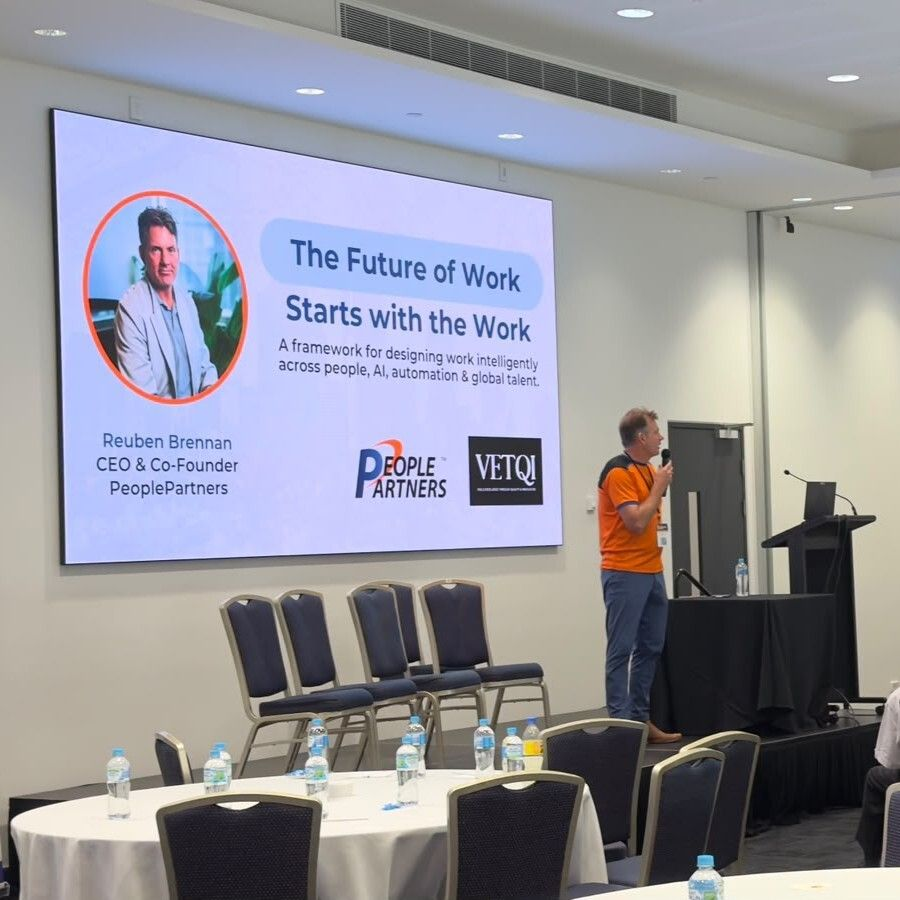
VETQI Summit Brisbane 2026 brought RTO and VET leaders together at the Royal International Convention Centre in Brisbane on 16 and 17 September 2026, with sessions focused on quality, innovation, technology, workforce capability, and the future of vocational education.
PeoplePartners CEO Reuben Brennan presented “The Future of Work Starts with the Work: A framework for designing work intelligently across people, AI, automation & global talent.” His session made one practical point clear: RTOs cannot get the best from AI, automation, offshore support, or internal teams if the work itself has not been designed properly first.
Key takeaways:
- The Wow Curve shows that progress moves through disruption, innovation, stabilisation, and plateau, which means RTOs need to keep redesigning how work gets done.
- The old way of working stops working at scale when roles get wider, leaders stay stuck in execution, and growth creates drag instead of leverage.
- The two AI revolutions are not only about replacing repetitive tasks, but also about amplifying capable people inside better-designed roles.
- The 6 Decisions of Work Design give RTO leaders a practical way to decide whether work should be eliminated, simplified, automated, supported by AI, globalised, or humanised.
- How PeoplePartners Empowers RTOs and VET Providers with Smarter Student Support Models. Streamline operations and strengthen learner support with dedicated teams tailored to your organisation’s needs.
What the Wow Curve Says About RTO Change
The Wow Curve frames progress as a pattern: disruption creates the need for change, innovation opens a window for new ways of working, systems stabilise the improvement, and eventually the model plateaus until another reinvention is needed. In Reuben’s session, this curve helped explain why the work that once supported growth can eventually become the thing that slows it down.
| The Wow Curve for RTO Workforce Change | ||
|---|---|---|
| Stage | What it means | What it can look like in an RTO |
| Fracture | The old way becomes harder to sustain. | Admin load increases, roles widen, and leaders notice more rework, delays, and pressure on key people. |
| Wow window | A period where new thinking and bold redesign can create a step change. | RTOs rethink student administration, scheduling, reporting, learner support, and repeatable execution work. |
| Healthy how | Systems, order, and optimisation stabilise the new model. | Work is grouped into clearer roles, handovers improve, and teams become easier to lead and onboard. |
| Plateau | The model becomes familiar, but eventually needs reinvention again. | A once-effective structure starts to create bottlenecks as the RTO grows or the operating environment changes. |
This is why Workforce Re-Engineering matters for RTO leaders. It gives teams a way to redesign the operating model before adding more people, more tools, or more pressure. That same focus on intentional design also aligns with ASQA’s guidance on the 2025 Standards for RTOs, which points to the importance of quality-driven systems that support effective delivery.
Why Old Operating Models Start to Strain at Scale
As organisations scale, the old way of working can stop working. Reuben’s session framed this as a design problem: without redesigning how work gets done, growth can create drag instead of leverage. Roles get wider, execution depends too heavily on key individuals, staff become overloaded, and leaders remain stuck in the work.
PeoplePartners’ article on RTO workforce management explores this same issue in more detail: smart scaling depends on role clarity, not just adding capacity. Once the work is clearer, RTO leaders can build their team by shaping dedicated offshore support roles around repeatable work, task clusters, and the operating rhythm their local team needs.
Harvard Business Review’s Do You Have a Well-Designed Organization? adds a useful organisational design lens here. The article points to the risk of overly complex structures and unclear responsibilities, which is exactly what can happen when one RTO role carries too many handovers, admin tasks, reporting requirements, and decision points. As work becomes harder to own clearly, the operating model starts to slow down, even when the team is working hard.

What the 2 AI revolutions mean for RTO leaders
Reuben’s framework identified two AI revolutions happening at the same time: Agentic AI and AI-Enhanced Humans. Agentic AI focuses on replacing repetitive execution through automation, workflows, systems, and task replacement. AI-Enhanced Humans focus on amplified operators, faster execution, better communication, stronger decisions, leveraged leadership, and scalable capability.
The difference matters in three ways:
- Agentic AI needs clean work to execute.
AI can support repeatable tasks, but it still needs clear inputs, rules, ownership, and review points. - AI-enhanced humans need clear roles to perform well.
A capable operator cannot use AI effectively when their work is scattered across an overloaded role or unclear handovers. - Workforce design should come before AI adoption.
AI can amplify speed, communication, decision-making, and output, but it can also amplify bottlenecks, fragmented workflows, overloaded roles, and poor operating design.
The broader AI conversation points in the same direction. Microsoft’s Work Trend Index on agents and human agency frames the opportunity around agents taking on execution while human judgment remains central to the work that matters. McKinsey’s article on agentic organisations also points to the need to reimagine workflows, leadership roles, skills, and culture as AI becomes more embedded in work.
How the 6 Decisions of Work Design Create a Practical Filter
The 6 Decisions of Work Design give RTO leaders a simple way to stop jumping straight to a solution. The framework asks whether work should be eliminated, simplified, automated, supported by AI, globalised, or humanised.
This matters because not every task needs a new hire. Not every workflow should be automated. Not every responsibility should move offshore. Some work should be removed. Some work should be simplified. Some work should stay close to local judgement, relationships, and provider-owned review.
| The 6 Decisions of Work Design for RTO Leaders | ||
|---|---|---|
| Decision | Leadership question | RTO example |
| Eliminate | Does this work still need to happen? | Remove duplicate admin steps, repeated data entry, or low-value reporting habits. |
| Simplify | Can the workflow be made clearer before it is delegated? | Standardise enrolment follow-up, evidence requests, or trainer schedule updates. |
| Automate | Is the work rule-based and predictable? | Automate reminders, form routing, status updates, or repeatable workflow notifications. |
| AI | Can AI support execution once the role and review points are clear? | Use AI to support drafting, summarising, triage, or structured communication where humans retain review. |
| Globalise | Could repeatable support work sit in a dedicated global talent role? | Move clearly scoped admin, scheduling, CRM updates, or document handling into a support layer. |
| Humanise | Does the work require judgement, trust, empathy, or local ownership? | Keep sensitive student decisions, provider-owned review, relationships, and high-context judgement with local owners. |
The value of this framework is that it slows the decision down before leaders jump to a solution. This approach aligns closely with PeoplePartners RTO support, because offshore support works best when roles are designed around clear, repeatable task clusters. Once the work is clarified, Workforce Re-Engineering gives RTOs a stronger way to decide what should stay local, what can move into a support layer, and where AI or automation can add value without adding confusion.
How PeoplePartners Helps RTOs and VET Providers Build Better Support Models
PeoplePartners works with businesses as a strategic workforce partner, helping build dedicated offshore teams from the ground up, tailored to client needs, culture, and industry. For RTOs and VET providers, that support starts with the work itself.
Instead of treating offshore support as a quick fix for overloaded teams, PeoplePartners helps leaders think through role design first. That means looking at which tasks are recurring, which tasks require local judgement, which tasks need provider-owned review, and which tasks can sit in a clearer support layer.
PeoplePartners reduces the friction that can stop leaders from redesigning their support model by making the next step lower risk:
- Zero Upfront Cost: Get started without paying anything upfront.
- No Lock-In Contract: Stay because it works, not because you are locked in.
- 90-Day Replacement Guarantee: If it is not the right fit, PeoplePartners will find a replacement at no extra cost.
PeoplePartners helps clients access talent precisely matched for them, then supports recruitment, onboarding, IT, payroll, HR, Philippines employment compliance, and employee experience as an employer of record. Learn more about what PeoplePartners does or watch our client stories that have built offshore teams with us.

Redesign Your RTO Support Model
VETQI Summit Brisbane 2026 reinforced a practical message for RTO leaders: better workforce performance starts with better work design.
Before adding more people, tools, AI, automation, or offshore support, look at how the work is currently structured. A task audit can show where roles are overloaded, where work should be segmented, and where dedicated support could create more capacity without pushing unclear work onto another person.
Frequently Asked Questions (FAQs)
RTO roles can become overloaded when growth adds more reporting, scheduling, student queries, documentation, evidence collection, and coordination into the same seats without redesigning how the work is grouped.
RTO roles often become overloaded because work keeps being added to the person who already knows the business. Student administration is a common example. The supplied workshop presentation shows how one role can absorb AVETMISS reporting, AASN liaison, enrolment processing, trainer scheduling, evidence collection, audit preparation, and student queries.
A role may need redesign when it is hard to hire for, slow to onboard, too dependent on one person’s memory, or constantly pulling leaders back into recurring execution. Another sign is when the role mixes too many different work types, such as student communication, scheduling, reporting preparation, evidence collection, and internal coordination. The issue may not be effort. The role may simply be carrying too many execution layers.
AI should fit after role clarity. RTO leaders need to know who owns the task, what the workflow step is, what review rule applies, and where handovers happen before AI is added. AI can support structured preparation, drafting, sorting, and repeatable work, but judgement, sensitive decisions, learner impact, and final accountability should stay with the right local owner.
Global talent can support repeatable work once the role has clear boundaries, handover rules, and review points. For RTOs, that may include administration support, reporting preparation, scheduling coordination, CRM updates, document control, enrolment support, LMS administration, and student support coordination. Workforce Re-Engineering helps decide what should move, what should stay local, and what needs review before the work is transferred.
