What if improving profitability in your RTO starts before you hire another person or add another system?
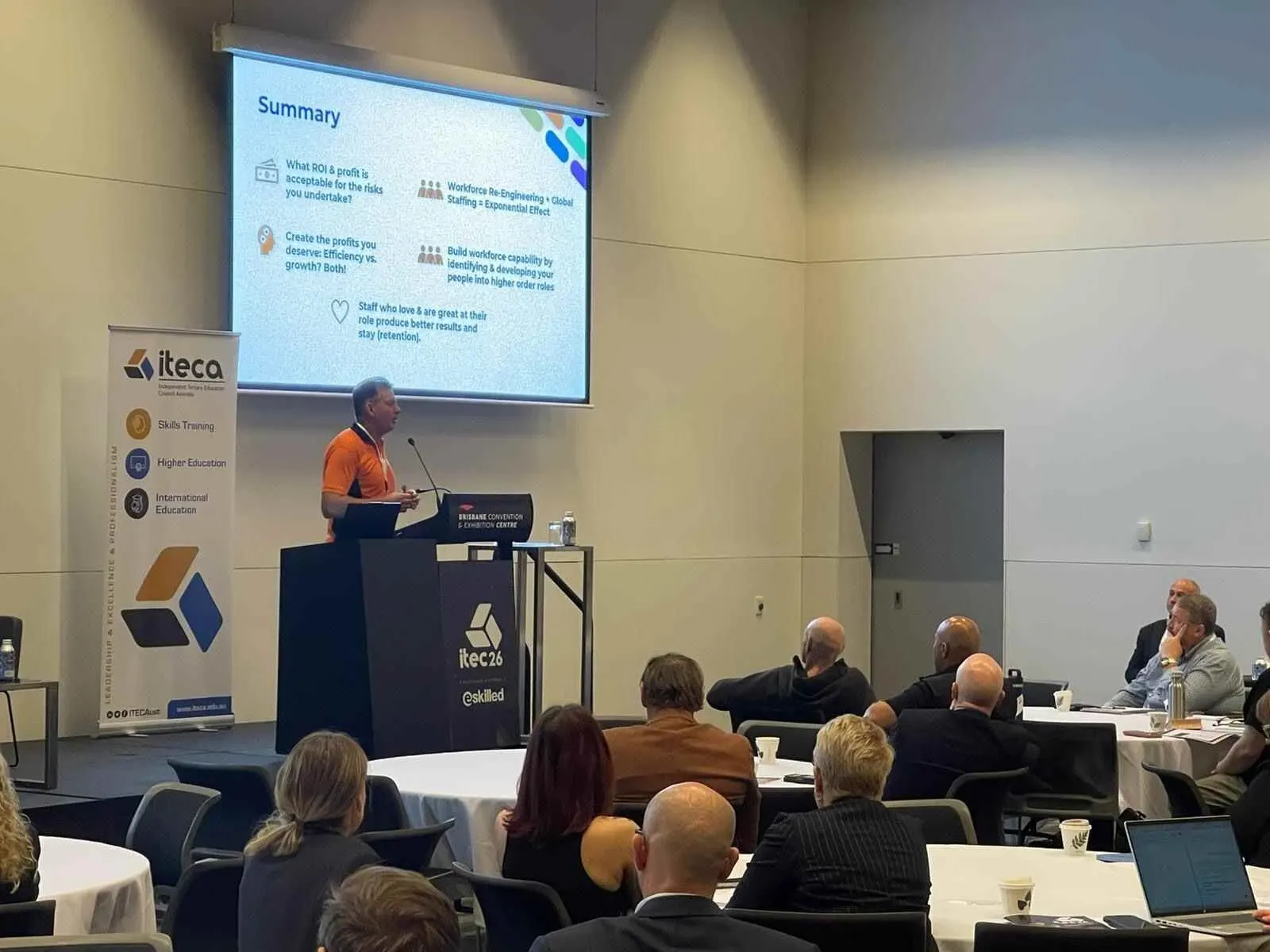
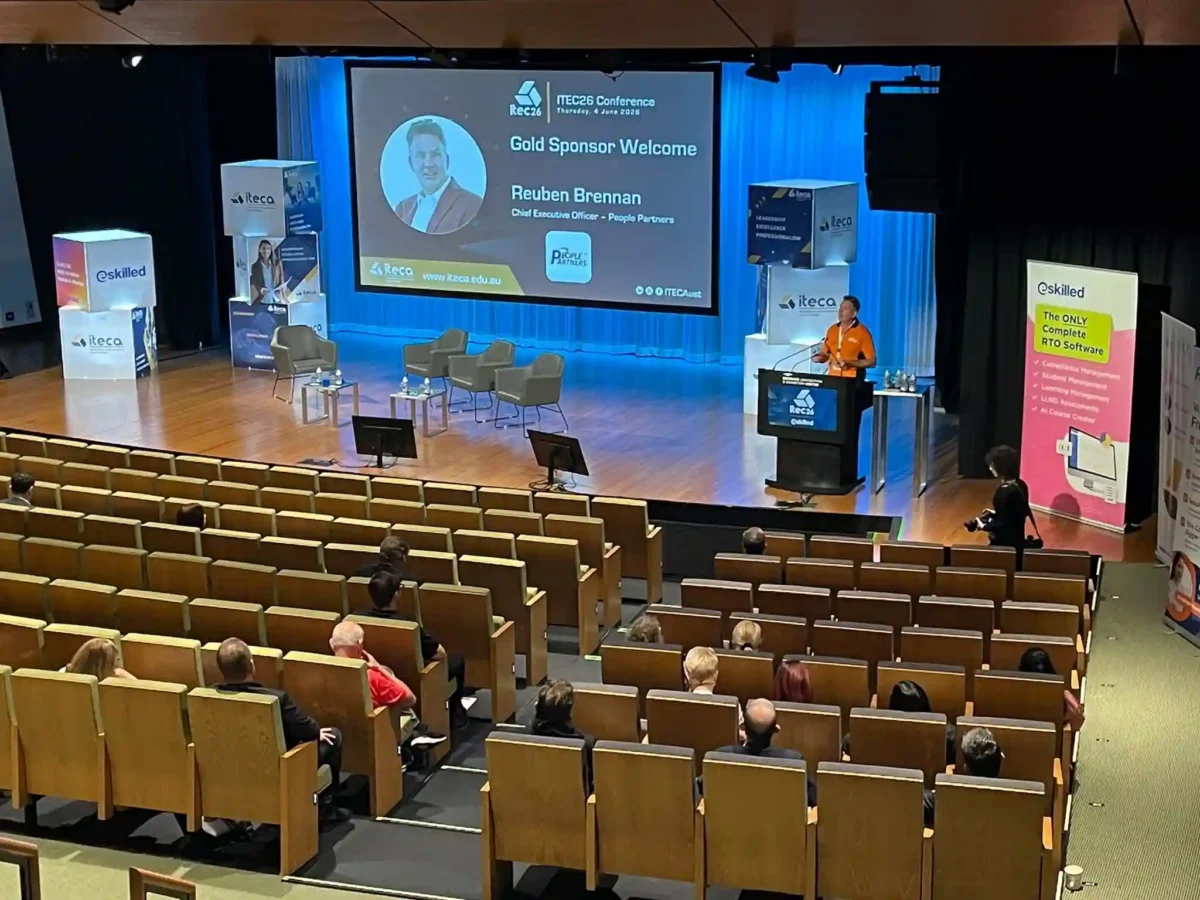
That was the challenge Reuben Brennan, CEO of PeoplePartners, shared with Australian RTO leaders at the ITEC26 Conference.
In his presentation, “Maximising Profitability & Workforce Capability,” Reuben explained that stronger margins often begin with better workforce design. For RTOs managing compliance, student experience, trainer capability, and changing VET requirements, growth can create more pressure when roles and workflows are unclear.
Instead of simply adding more people, Reuben encouraged leaders to first ask a sharper question: is the work structured in the right way?
The Big Takeaway: Efficiency Can Beat Growth
One of the strongest messages from Reuben’s presentation was clear: efficiency can beat growth.
Many RTOs focus heavily on growth. They work to:
- Increase revenue
- Win more contracts
- Serve more learners
- Expand delivery
These goals matter. However, growth does not automatically lead to profit if the operating model behind it remains inefficient.
As Reuben highlighted, RTOs cannot simply outgrow inefficiency. In fact, growth can make the problem worse:
- More students can create more administration.
- More delivery can create more coordination.
- More compliance activity can create more manual handling.
- More revenue can disappear into duplicated work, unclear roles, and overloaded teams.
Therefore, the real takeaway is not growth or efficiency. It is growth through efficiency.
RTO leaders need an operating model that turns growth into sustainable profit. That means redesigning how work gets done, clarifying responsibilities, and building a workforce structure that supports scale without adding unnecessary pressure.
The Four Assumptions That Keep Workforce Problems Hidden
Reuben outlined four common assumptions that often show up when organisations try to scale:
1. Discipline assumes the roles are right.
2. Delegation assumes the roles are right.
3. Labour duplication assumes the roles are right.
4. Technology assumes the roles are right.
Each approach can help an RTO improve performance. However, they only work when the structure underneath them is clear and fit for purpose.
For example:
- If a role is overloaded, delegation may only move confusion from one person to another.
- If workflows are fragmented, technology may simply digitise the mess.
- If responsibilities overlap, hiring more people may create more handoffs instead of more capacity.
- If leaders add discipline without redesign, teams may become busier without becoming more effective.
Therefore, RTO leaders need to step back before they scale. Instead of asking, “How do we add more?”, they should ask a more strategic question:
Are our roles actually designed for the work we need to deliver now?
The Exponential Effect: Workforce Re-Engineering Plus Global Staffing
A major highlight of Reuben’s session was his explanation of what happens when RTOs pair Workforce Re-Engineering with Global Staffing.
First, Workforce Re-Engineering helps leaders redesign the work before they redesign the team. It allows RTOs to:
1. Separate complex tasks into clearer workstreams
2. Clarify responsibilities across roles
3. Identify where capability is being wasted
4. Narrow roles so teams can train, manage, and scale them more easily
Then, Global Staffing becomes more powerful because the offshore roles are no longer vague catch-all positions. Instead, leaders can build intentional support roles that fit the operating model and create real capacity.
Reuben shared a commercial example to make this clear:
- A business spends $500,000 in labour to produce $700,000 in income.
- This means labour sits at 71% of income.
With Workforce Re-Engineering, labour cost can reduce to $250,000 while still producing $700,000 in income. - This brings labour down to 36% of income.
- When the business adds Global Staffing strategically, labour can reduce further to $75,000, or 11% of income.
In this example, the business reduces labour intensity by 85% and increases gross margin from $200,000 to $625,000.
The broader lesson is clear: workforce design can change business economics. When RTOs redesign the work first, they can use purpose-built offshore support more strategically, reduce unnecessary labour pressure, and build a more scalable operating model.
Why This Matters for RTO Profitability and Long-Term Business Success
RTOs carry significant responsibility. Every day, they manage:
- Learner outcomes
- Compliance expectations
- Delivery quality
- Trainer capability
- Documentation and systems
- Stakeholder expectations
During his session, Reuben asked a question every RTO leader should consider:
What level of ROI and profit is acceptable for the risk your organisation carries?
This question matters because many RTOs operate with high responsibility but thin margins. When leaders, trainers, assessors, and skilled staff spend too much time on low-value work, the organisation may work harder than the profit result justifies.
That is where better workforce design can release hidden profit.
By redesigning how work gets done, RTOs can:
- Move the right work to the right level
- Protect expensive capability
- Reduce unnecessary pressure on senior staff
- Create clearer support around trainers, assessors, compliance teams, student support, and operations leaders
As a result, RTOs can improve profitability without simply adding more work, more roles, or more pressure to already stretched teams.
The Field Trainer Example: Redesign the Work Before Adding More People
One of the most practical parts of Reuben’s presentation was the field trainer example.
On paper, an RTO’s trainer team may look fully resourced. However, the reality can look very different. Trainers often carry a heavy mix of responsibilities, including:
1. Travel
2. Learner interaction
3. Administration
4. Marking
5. Quality activity
6. System updates
7. Coordination
8. Follow-up
As a result, trainers can lose valuable time to tasks that sit outside their highest-value work.
Reuben showed how leaders can make this workload visible by breaking tasks into clearer categories, such as:
- Inside versus outside tasks
- Work people love versus work they dislike
- Interpersonal versus detail-heavy responsibilities
- Customer-facing versus non-customer-facing activities
- Tasks that require different technologies, systems, or processes
Once leaders can see the work clearly, they can redesign the department more effectively.
In a re-engineered model, trainers stay focused on higher-value training and learner engagement. Meanwhile, support functions such as student support, training coordination, marking, and QA are separated into clearer roles.
This structure protects trainer capacity, improves the experience around them, and helps the organisation use skilled capability more intentionally.
For RTOs, this matters because trainer and assessor capability remains one of the most valuable resources in the organisation.
Capability Development Must Match the Role
Reuben also connected workforce design with workforce capability development. A better structure only works when people receive the right development for the roles they are actually meant to perform.
In the presentation, he mapped capability needs across several key RTO functions, including:
1. Trainer and assessor
2. Quality and compliance officer
3. Instructional designer
4. Student support and administration
5. LMS administration and support
Each role requires a different development pathway.
For example, trainer and assessor capability may include:
- Assessment design
- AQF levels
- Universal Design for Learning
- Cultural awareness
- Supporting students with anxiety
Meanwhile, quality and compliance roles may need stronger capability in:
- Currency documentation
- Evidence retention
- Risk management
- New standards
- Qualification packaging rules
Instructional designers may need development in online delivery, inclusive curriculum design, cognitive load, and assessment design. Student support teams may need training in vulnerable learners, literacy support, anxiety, and neurodiversity. Likewise, LMS and general support roles may need capability in hybrid delivery, digital tools, online quality assurance, accessibility, and learner digital skills.
However, one shared foundation sits across all roles: understanding VET 2026 and the 2025 VET reforms.
From there, capability development should become role-specific. Instead of giving every team member the same training, RTO leaders can build targeted development pathways that match the work each role actually needs to deliver.
Retention Improves When People Are in the Right Seat
Another key message was that staff who love and are great at their role produce better results and stay.
This is a powerful retention insight for RTO leaders. A strong trainer may become frustrated when too much time is lost to administration. A compliance specialist may struggle when constantly pulled into urgent coordination. A student support team member may care deeply about learners but feel overwhelmed by disconnected systems.
Workforce Re-Engineering helps reduce that friction. It identifies where people create the most value, which tasks drain capacity, and where support roles can improve both performance and retention.
What RTO Leaders Can Do Next
The most practical next step from ITEC26 is simple: pressure-test the org chart.
Reuben encouraged RTO leaders to look closely at their current structure and identify where the organisation may be losing capacity, margin, or momentum. This means looking for:
- Overloaded execution
- Misaligned labour spend
- Hidden profit inside the existing team structure
A helpful place to start is with three questions:
- Which roles are carrying too many unrelated responsibilities?
- Which high-value people spend too much time on low-value or repetitive work?
- Which tasks could be redesigned, systemised, or supported by global staffing without compromising quality, compliance, or learner experience?
The goal is not to replace local expertise. Instead, the goal is to protect it.
Trainers, assessors, compliance leaders, and operational managers should spend more time on work that requires their judgement, sector knowledge, and experience. By redesigning the work around them, RTOs can create more capacity, reduce operational pressure, and build a stronger foundation for sustainable growth.
Final Takeaway: Build the Profit and Capability Your RTO Deserves
Reuben Brennan’s ITEC26 presentation made one message clear: sustainable profitability comes from both efficiency and growth.
For RTOs, this means improving the way work gets done before adding more headcount, systems, or pressure. Three levers can help leaders create that shift:
1. Workforce Re-Engineering redesigns the work.
2. Global Staffing extends capacity.
3. Capability development helps people move into higher-order roles.
Together, these levers can create stronger margins, better role fit, and more sustainable growth.
So, if your RTO is growing but margins still feel tight, skilled people are overloaded, or leaders remain stuck in day-to-day execution, it may be time to look beyond hiring and start redesigning.
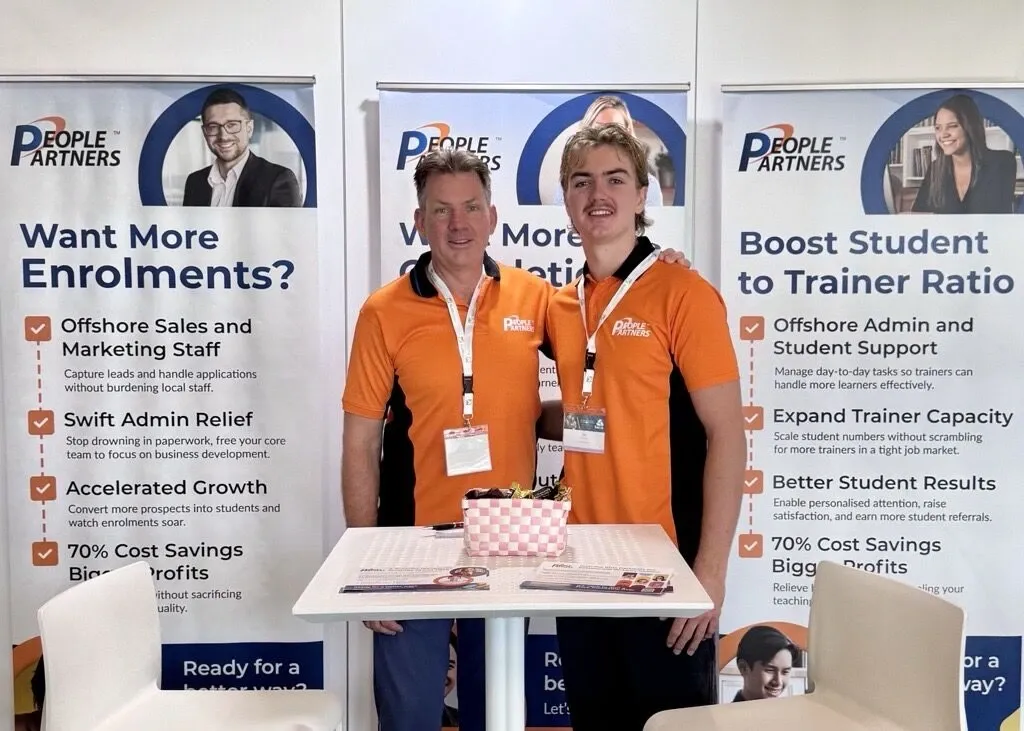
PeoplePartners helps RTOs build scalable workforce models through Workforce Re-Engineering, Global Staffing, and role-based support structures. To assess operational and compliance risk more clearly, download the 2026 RTO Audit Readiness Checklist.
Ready to go deeper? Contact PeoplePartners to pressure-test your org chart and uncover where hidden profit and capability may already exist inside your current structure.
Frequently Asked Questions (FAQs)
Workforce Re-Engineering helps RTOs redesign tasks, roles, and workflows so the right work sits with the right people. It can help reduce duplication, protect high-value capability, and create clearer support around trainers, assessors, compliance teams, and operations leaders.
Workforce design is important because many RTOs carry complex responsibilities across compliance, trainer capability, student support, delivery quality, and operations. When roles are unclear or overloaded, growth can create more pressure instead of more profit.
Global Staffing can help RTOs extend capacity by moving well-defined support tasks into offshore roles. When paired with Workforce Re-Engineering, global staffing becomes more strategic because roles are designed clearly before they are filled.
Better workforce design can support roles across training, assessment, student support, administration, quality assurance, compliance, instructional design, LMS administration, and operations. The goal is to help each role focus on the work that creates the most value.
RTOs should pressure-test their org chart to identify overloaded roles, misaligned labour spend, duplicated responsibilities, and hidden capacity inside the existing structure. This helps leaders see whether the current team design supports growth or creates unnecessary pressure.