AI is everywhere right now. Businesses are adopting tools, automating workflows, and hearing the same message again and again: AI can solve almost every growth problem.
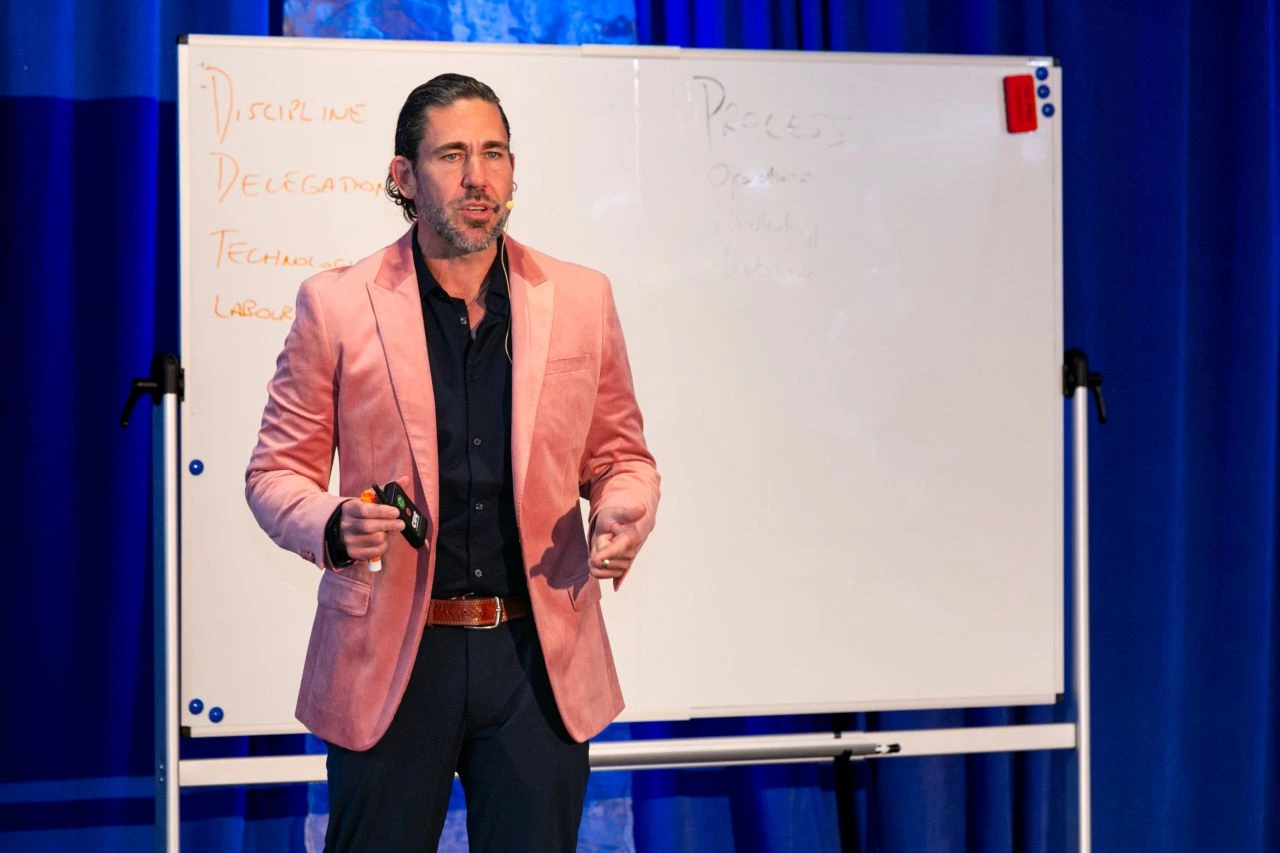
But at CoachCon 2026, a different perspective was brought into the conversation. Anthony Rice, Co-Founder of PeoplePartners, shared that the real advantage does not come from using more AI. It comes from designing the workforce well enough for AI to make a meaningful impact.
In his presentation, “The AI Advantage Isn’t AI. It’s Workforce Design,” Anthony challenged a common belief in business growth. Many companies are moving fast to reduce costs, increase output, and automate more tasks. But when the work itself remains unclear, inefficient, or poorly structured, AI does not fix the problem. It simply speeds up the mess.

The Big Idea: Businesses Are Optimizing the Wrong Thing
When pressure starts to build inside a growing business, leaders often try to fix it by improving one of four areas:
1. Discipline. Leaders ask people to work harder, move faster, or stay more focused.
2. Delegation. More tasks are handed off so leaders can free up their time.
3. Labor leverage. Additional support is hired to reduce the workload.
4.Technology. New software, AI tools, or automation are introduced to improve efficiency.
These solutions can help, but only when the underlying structure is already working.
As Anthony highlighted, the problem is that many of these decisions are based on one major assumption: that the role itself is already correct.
It is often assumed that:
- The org chart makes sense
- The workflows are worth improving
- The current roles are properly designed
- The right people are doing the right work
But what if the role itself is the problem?
That question shifts the conversation from productivity to design. A business may not have a labor cost problem, a profit problem, or even a staff retention problem at its core. It may have a workforce design problem.
Accountability Is Not the Same as Capacity
One of the strongest points from Anthony’s presentation was the difference between accountability and capacity. A leader can make someone accountable for an outcome. But that does not always mean the role has enough:
- Capacity to handle the workload
- Clarity around what matters most
- Focus to deliver the outcome well
Many growing businesses get stuck here.
For example, one person may be responsible for:
- Admin tasks
- Client communication
- Reporting
- Scheduling
- Marketing coordination
- CRM updates
- Finance follow-ups
- Internal operations
On paper, that may look like one role. In reality, it is several roles bundled together.
When this happens, delegation becomes messy. Training becomes harder. Performance becomes inconsistent. The business becomes dependent on “unicorn” employees who are expected to do everything.
As Anthony’s presentation made clear, chaos cannot be delegated.
The CEO Dilemma: Why "I Need a VA" Is Often Too Broad
Anthony used the CEO dilemma to show how easily delegation breaks when businesses do not redesign the work first.
Many founders reach a point where they think: “I just need someone to help.”
That person may start as a VA, assistant, or general support hire, but over time, the role often expands into an unrealistic mix of calendar management, invoices, emails, customer support, website updates, SEO, blogs, social media, video editing, AI tools, IT support, and anything else that needs to be done. At that point, the business is no longer hiring for one clear role. It is expecting one person to cover several functions at once.
The issue is not that support is unnecessary. The issue is that the work has not been properly segmented.
A stronger workforce design separates the work into clearer, more focused roles, such as:
- Executive assistant
- Bookkeeper
- Customer support specialist
- Marketing Specialist
- IT support
- Developer support
When work is segmented this way, each role becomes easier to train, manage, and repeat.
For business leaders, this is an important shift. The goal is not to hire one person to absorb everything. The goal is to redesign the work so the right person owns the right type of task.
To see what this can look like in practice, visit Build Your Team to explore the PeoplePartners roles that can support a more focused, scalable workforce.

Workforce Re-Engineering Turns Overloaded Roles Into Execution Systems
Another key highlight from Anthony’s presentation was the role of Workforce Re-Engineering. Instead of asking, ‘Who can we hire?’ workforce re-engineering asks, ‘How should the work be structured?’
This shift matters because hiring alone does not always solve the real problem. Before a role is filled, the work needs to be reviewed and redesigned.
That means looking at five key areas:
1. The current org chart. Where does the work sit today, and does that structure still make sense?
2. Overloaded roles. Which people are carrying too many unrelated responsibilities?
3. Repetitive tasks. Which tasks are routine, repeatable, or better suited for support roles?
4. Technical and administrative work. Which tasks require specialist skills, and which tasks are operational or process-driven?
5. Leadership and strategic work. Which tasks require decision-making, client relationships, or face-to-face leadership?
From there, the business can group tasks into clearer clusters and match each cluster to the right type of role.
For example:
- Some tasks may be simple and repetitive.
- Some may require technical skill.
- Some may require client relationships.
- Some may need leadership, strategy, or decision-making.
When a business mixes all of these into one role, it pays a high opportunity cost. Skilled leaders spend time on low-value tasks. Technical work slows down. Administrative work becomes scattered. Growth becomes harder to manage.
Anthony’s presentation showed that better workforce design can improve five important areas:
- Time
- Cost
- Fulfillment
- Scalability
- Business valuation
The deeper point was not simply about saving money. It was about designing the business to operate better.
AI Does Not Fix Broken Execution. It Exposes It.
AI was one of the biggest themes of the presentation, but Anthony avoided the usual AI hype.
His message was more practical: AI is a force multiplier. It amplifies what already exists.
If a business has clear roles, structured workflows, strong communication, and repeatable systems, AI can improve speed, output, decision-making, and execution. But if a business has chaos, bottlenecks, overloaded roles, fragmented workflows, and poor operating design, AI can amplify those weaknesses too.
The Two AI Revolutions Leaders Need to Understand
Anthony also explained that there are two AI revolutions happening at the same time.
The first is Agentic AI. This focuses on replacing repetitive execution through automation, workflows, systems, and task replacement.
The second is AI-enhanced humans. This is where capable operators use AI to work faster, communicate more clearly, make better decisions, and execute more effectively.
That is where workforce design becomes the advantage. Businesses that redesign work first can decide which tasks should be automated, which roles should be supported by global talent, and which high-value responsibilities should stay with leaders and strategic operators.

The Economics of Better Workforce Design
The presentation also connected workforce design to business economics. Anthony showed how a legacy labor model can consume a large percentage of revenue. Through workforce re-engineering, global talent, and AI, a business can reduce labor intensity while increasing gross margin.
The key lesson is simple: operational design affects more than payroll.
It also shapes:
1. Margins. Better workforce design helps reduce wasted labor spend and improve profitability.
2. Scalability. Clear workflows and focused roles help the business grow without adding unnecessary complexity.
3. Leadership bandwidth. Owners and leaders gain more time to focus on strategy, growth, and higher-value decisions.
4. Employee fulfillment. People perform better when they own clearer responsibilities and avoid constant role overload.
5. Business valuation. A business becomes more valuable when it can operate without depending too heavily on the owner.
For owners thinking about growth, acquisition, succession, or exit, this matters.
Buyers do not simply buy busy businesses. They buy execution systems.
How Leaders Can Spot a Workforce Design Problem
Anthony’s presentation gave business owners a practical way to start diagnosing the issue.
First, review your organizational chart. Look for roles that are hard to hire for, have high attrition, take too long to onboard, combine technical and administrative work, or create rework and double handling.
Second, complete a task audit. Break the work into clusters. Separate low-value repetitive tasks from high-value strategic tasks. Identify which responsibilities require people skills, technical skills, face-to-face interaction, or process execution.
Third, ask whether each role is narrow enough to be trained, measured, and repeated. If the answer is no, the next hire may not solve the problem. The next AI tool may not solve it either. The business may need workforce re-engineering before it needs more headcount or technology.

The CoachCon 2026 Takeaway: Redesign Work First, Then Scale
The clearest takeaway from Anthony Rice’s CoachCon 2026 presentation is this: the businesses that win in the AI era will not necessarily be the ones with the most people or the most tools. They will be the ones with the best-designed execution models.
AI, delegation, technology, and global talent can all create leverage, but they work best when a business has already clarified how work should flow. For business owners, the real opportunity starts with a better question.
Not ‘How do we move faster?’
But ‘What are we actually asking our people, systems, and tools to do?’
That is where real leverage begins.
Is Your Business Designed for the AI Era?
If your team stays busy without gaining real capacity, your leaders remain stuck in execution, or AI creates more activity than clarity, your business may not need more tools yet. It may need better workforce design.
PeoplePartners helps growing businesses rethink work through Workforce Re-Engineering, strategic offshore talent, and scalable execution support, so teams can reduce pressure, build capacity, and scale with more clarity.
Ready to identify where your business is overloaded, where labor spend is misaligned, and where real leverage can be created through AI and global talent?
Download the free AI vs. Offshore: The 2026 Hybrid Sourcing Model Playbook to explore the hybrid workforce model every executive needs in 2026. This practical guide helps CEOs, COOs, and Operations Leaders combine AI automation and offshore teams to improve speed, quality, and cost without losing control.
Contact Us to explore how PeoplePartners can help you design a workforce built for the AI era.
Frequently Asked Questions (FAQs)
Before adding more tools or headcount, business owners should review their org chart, audit key tasks, and identify where work is overloaded or misaligned. This helps them understand whether they need more people, better systems, offshore support, AI, or a redesigned execution model.
AI can speed up output, communication, and execution, but it can also amplify chaos if the business has broken workflows or overloaded roles. Anthony highlighted that AI does not automatically fix poor execution. Instead, it exposes weak systems, unclear responsibilities, and inefficient operating design.
Workforce Re-Engineering is the process of reviewing how work is structured inside a business, then redesigning roles, responsibilities, and workflows for better efficiency. It helps businesses separate high-value strategic work from repetitive, administrative, or technical tasks so the right people can focus on the right work.
Workforce re-engineering improves profitability by aligning tasks with the right level of skill, cost, and responsibility. It helps leaders reduce wasted labor, remove duplication, improve role clarity, and free high-value team members to focus on strategic work.
Global talent can create leverage when paired with clear workforce design. Once tasks are properly segmented, businesses can identify which roles can be supported offshore, which should remain local, and which can be enhanced through technology or AI.
