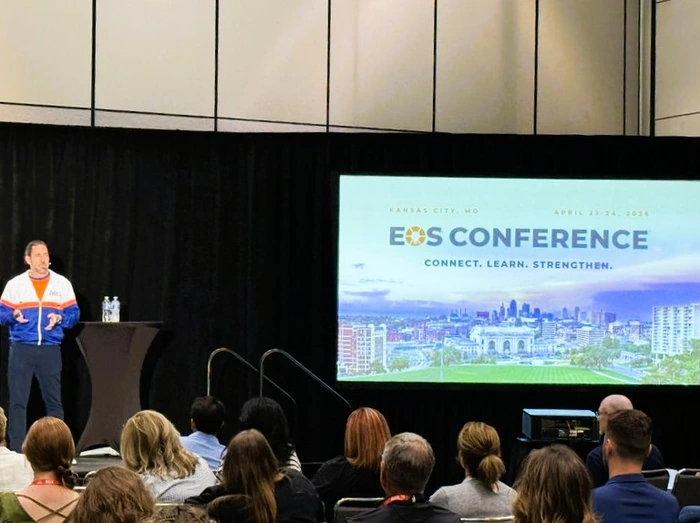
The EOS Conference Kansas 2026 brought together some of the most driven founders, Visionaries, and Integrators in the EOS community. The theme was clear. Connect. Learn. Strengthen.
Built around the principles of the Entrepreneurial Operating System (EOS), the event focused on helping businesses scale with clarity, discipline, and accountability.
But one idea stood out above everything else. Most EOS businesses are not stuck because they lack effort, discipline, or tools. They get stuck because they optimise the wrong thing.
At PeoplePartners, this was the message delivered by our co-founder, Anthony Rice. And it hit hard for leaders navigating the real pressure of scaling.
The Reality of Scaling EOS Businesses
If you were in Kansas, you would have heard the same conversations again and again. Not just during sessions, but in the hallways, at networking events, and over coffee between breaks.
Growth is happening. But it is not getting easier. Growth is creating a new level of complexity that many EOS-run businesses did not anticipate.
Across the board, we are seeing the same patterns:
- Complexity compounds faster than revenue
- Margins tighten even as sales increase
- Leaders stay stuck in execution instead of strategy
- Roles expand instead of becoming clearer
- Team fatigue and attrition rise
This is not a failure of EOS. It is what happens when your workforce structure does not evolve at the same pace as your business. And that gap is where friction begins.
Why Delegate and Elevate® Isn’t Enough
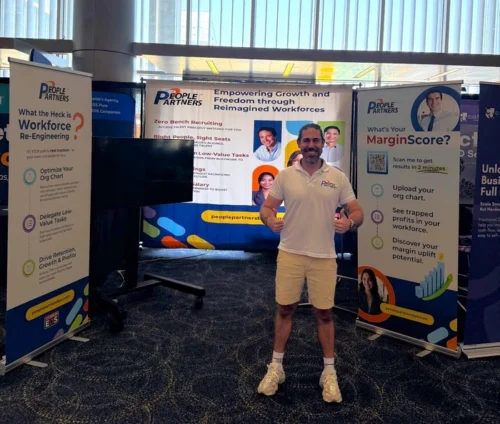
EOS gives leaders powerful tools. One of the most widely adopted is Delegate and Elevate®. And it works. But only to a point.
What many leaders in Kansas realised is this. Delegation is not the problem. Structure is. When pressure builds, most businesses respond the same way:
- They delegate more tasks
- They introduce new systems
- They hire additional people
- They layer in more technology
These are all logical moves, but they rely on one key assumption. That the seat itself is already correct. And often, it is not. You can delegate tasks all day. But if the role is overloaded or misaligned, you are simply redistributing inefficiency. That is why many leaders feel like they are doing everything “right” on EOS, but still not getting the results they expected.
The Real Issue: Workforce Design
This was the point in the session where the conversation shifted, because it reframed the problem entirely. Most businesses assume they are dealing with a labor cost, hiring, or retention issue. In reality, the root cause is often something deeper. Workforce design.
That distinction matters. When you misdiagnose the problem, every solution you apply, whether it is hiring, delegation, or new systems, only treats the symptoms and not the cause.
Inside many EOS businesses, accountability charts look clean and roles appear clearly defined. But in practice, the people in those seats are often overloaded. They juggle too many responsibilities, switch context constantly, and carry a mix of technical and administrative work that pulls them in different directions.
Over time, this creates compounding issues across the business:
- Slower execution
- Increased errors and rework
- Frustration across teams
- Leaders stepping back into day-to-day operations
- Growth starting to stall
This is where the gap becomes clear. Accountability does not equal capacity, and no amount of delegation will fix a role that was not designed properly in the first place.
What Workforce Re-Engineering Looks Like in Practice

Workforce re-engineering is not about outsourcing for the sake of saving money. It is about redesigning how work flows through your business so that it actually supports scale.
One of the clearest examples shared in Kansas was what we call the “everything VA.”
You have probably seen it before. One person responsible for:
- Admin
- Marketing
- IT
- Customer support
- Content
- And everything in between
It feels efficient on paper, but in practice, it creates bottlenecks, inconsistency, and a heavy dependency on a single person.
When you step back and re-engineer that role, the structure starts to change in a meaningful way. Instead of relying on one overloaded seat, the work is redistributed into multiple focused roles, each designed around a specific function.
That typically looks like:
- Narrower
- Clearer
- Easier to train
- Easier to manage
- Easier to scale
This is where workforce re-engineering brings the concept of Right People, Right Seats to life. Not theoretical.
Real Results: From Overload to Scale
This is not just a theory. It is what we see consistently across businesses that make the shift. One example shared at the conference was a mortgage business running a “unicorn broker” model.
Each broker was responsible for everything:
- Sales
- Admin
- Client communication
- Processing
- Settlements
The outcome was predictable:
- High salaries
- Low output
- Burnout
- Team attrition
After re-engineering the workforce:
- Sales remained client-facing and onshore
- Support functions were broken into specialized roles
- Repeatable work was handled by offshore team members
The results were significant:
- Lower operational costs
- Higher productivity
- Faster turnaround times
- Record performance across listings and settlements
This is where building the right global team starts to create real leverage.
Not just cost savings. But clarity and momentum.
The Simple Framework to Get Started
One of the biggest takeaways from Anthony Rice’s breakout session in EOS Conference in Kansas was that you do not need to rebuild your entire business overnight. You just need to start in the right place.
1. Review Your Accountability Chart®
Look beyond titles and ask:
- Which roles feel overloaded?
- Which seats are hard to hire for?
- Where is turnover highest?
- Where does work get stuck or duplicated?
These are your signals that the seat may be wrong.
2. Run a Task Audit
Break work down into categories:
- High-value vs low-value tasks
- Technical vs administrative work
- Client-facing vs internal responsibilities
From here, you can begin to redesign roles based on focus, not convenience. This is where many businesses unlock what we call Freedom from Low-Value Tasks. Leaders stop getting pulled into low-value work and start focusing on what actually drives growth. This is where partnering with the right team makes the difference.
The Payoff: Profit, Scale, and Freedom
When workforce design is right, everything else starts to work. In the Anthony Rice’s breakout session, we shared what this looks like across different stages of business:
- A legacy model with high labor costs and limited margin
- A re-engineered model with improved efficiency
- A fully optimized model combining workforce design, global talent, and AI
The difference is not incremental. It is exponential. We are seeing:
- Labor costs drop significantly
- Margins expand
- Teams become more focused and productive
- Leaders step back into strategic roles
This is not about cutting costs for the sake of it. It is about building a business that can scale without breaking.
Final Takeaway from EOS Conference in Kansas
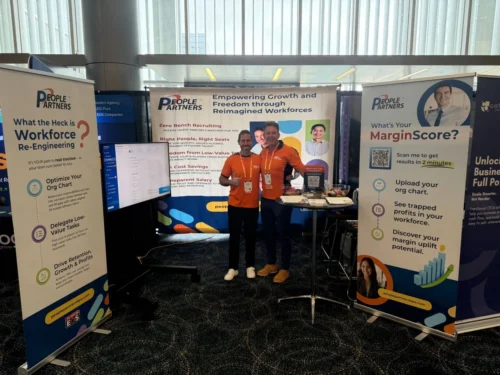
What came through clearly at EOS Conference Kansas 2026 is that for many businesses, the challenge is not effort or execution. It is structure.
You can have the right people in place, follow EOS closely, and still feel like growth is creating more pressure than progress. That usually comes down to how work is designed inside the business. When roles are overloaded or misaligned, even strong teams struggle to keep up, and leaders end up pulled back into the day-to-day.
At a certain point, every growing business runs into this decision. You can keep pushing within the same structure and hope things improve, or you can step back and redesign how the business actually operates so it can support the next stage of growth.
The businesses that take the time to get that design right are the ones that scale more smoothly, with less friction and more clarity around where time, effort, and talent should be focused.
Want to See Where Your Profit Is Stuck?
If you are running on EOS and feeling the pressure of growth, this is the next step. Identify:
- Misaligned roles
- Hidden inefficiencies
- Where profit is being lost inside your structure
Then fix the design.
If you are ready to take the next step, contact us to review how your team is structured and where the gaps are. No lock-in contracts. You stay in control. We help you build a team that actually scales with your business.