Growth should not automatically mean more pressure on brokers, leaders and support teams. However, as file complexity, client expectations and lender requirements increase, many mortgage brokerages find that their existing roles and workflows can no longer support the business effectively.
During the CMBA webinar, The Future-Ready Mortgage Brokerage: Why Top-Performing Brokerages Are Winning With Workforce Re-Engineering, Not Just More Brokers, Anthony Rice, Co-Founder of PeoplePartners, explained why simply adding more brokers, assistants, technology or offshore team members does not create a scalable operating model.
Instead, brokerages need to redesign how work is distributed before deciding which responsibilities should remain with brokers, move to specialist support roles, be managed by global talent or be supported by AI.
Key Takeaways
- Growth exposes weaknesses in the existing operating model. More volume can increase workload, complexity and key-person dependency when roles and workflows are unclear.
- Hiring another person will not fix a poorly designed role. Brokerages should identify bottlenecks and separate responsibilities before recruiting.
- Workforce challenges change as the brokerage grows. Solo brokers often manage overloaded roles, small firms duplicate inefficient positions, and larger firms experience duplication across teams and management layers.
- Future-ready brokerages assign work according to value and capability. Brokers focus on advice, relationships and lender strategy, while repeatable operational work receives dedicated ownership.
- Global talent performs best in clearly defined roles. Offshore professionals need focused responsibilities, structured handoffs and clear measures of success.
- AI should support well-designed workflows. It should not be used to compensate for unclear roles, broken processes or overloaded teams.
- The goal is controlled and profitable growth. A better-designed workforce can reclaim broker capacity, improve consistency and reduce dependence on a small number of key people.
Why Mortgage Brokerage Workforce Re-Engineering Matters Now
Mortgage brokerages are operating in a market shaped by changing demand, greater complexity and rising client expectations.
Anthony compared Australia’s mature broker channel with Canada’s developing market, noting broker share of around 75% in Australia versus 35% in Canada. He attributed Australia’s growth to consumer trust, aggregator support, regulatory confidence and stronger operating models.
Recent data supports this trend. MFAA reported that brokers accounted for a record 81.0% of Australian residential lending market in the March 2026 quarter. In Canada, CMHC found that 48% of mortgage consumers used a broker to manage negotiations.
The lesson for Canadian brokerages is clear. As broker demand grows, operating models must scale without placing more pressure on principals, senior brokers and support teams.
1. Growth Exposes the Structure You Already Have
Anthony’s key point was that complexity often grows faster than revenue.
A brokerage may appear successful while becoming harder to run. Enquiries, follow-ups, lender requirements and client communication increase, while margins tighten and leaders remain stuck in delivery.
Common warning signs include:
- Roles becoming broader instead of more focused
- Leaders staying involved in day-to-day work
- Margins tightening despite revenue growth
- Higher attrition in overloaded roles
- Business value depending on a few key people
Broker count alone does not show whether a business can scale. The better question is where the work sits and whether each role is focused on the right responsibilities.
2. The Usual Fixes Assume the Role Is Right

When a brokerage feels stretched, leaders often focus on discipline, delegation, technology or offshore support.
These can help, but only when the structure is sound. If roles are too broad, ownership is unclear or bottlenecks are built into the workflow, these solutions will not fix the underlying problem.
As Anthony explained, accountability is not the same as capacity. Someone may own an outcome but still lack the time, role clarity or support needed to deliver it consistently.
Many brokerages do not have a labour cost problem first. They have a workforce design problem.
3. Different Brokerage Sizes Have Different Constraints
Anthony broke the problem down across three brokerage stages: solo broker, small firm, and large firm. Each stage has a different design flaw.
Solo Broker: The Overloaded Role
For solo brokers, the main issue is often an overloaded role.
A single “VA” may be expected to handle loan processing, administration, bookkeeping, marketing, content, website updates and AI support. This combines too many skill sets into one position.
The better approach is to separate the work into focused roles before hiring. Depending on the bottleneck, the first hire may be a Fulfilment Officer, Back Book Manager or Compliance Assistant.
The goal is not to hire every role at once, but to identify where the work is stuck and design the right role around it.
Small Firm: Duplication Instead of Segmentation
Small firms often scale by duplicating overloaded broker roles.
In Anthony’s example, five brokers spent about 70% of their time on administration rather than revenue-generating work. After Workforce Re-Engineering, brokers focused on relationships and new business, while dedicated support roles handled fulfilment, underwriting, database management and accounts.
The result was $42 million in additional annual funded volume, 28 hours reclaimed per broker each week and a 25% increase in funded deals.
The lesson is clear. Small firms should segment work instead of replicating roles that already carry too much.
Large Firm: Duplication Creep
In larger brokerages, inefficiency often hides across management layers.
Anthony’s example showed senior staff repeating reporting, scheduling, coordination and CRM tasks that could be assigned to dedicated support roles.
After Workforce Re-Engineering, clearer roles were introduced across reporting, operations, data, CRM, compliance coordination and executive support. The result was $153 million in additional annual volume, 24 hours reclaimed per broker each week and a 40% increase in funded deals.
For larger firms, better role design reduces key-person dependency, protects leadership capacity and makes growth easier to manage.
4. Future-Ready Brokerages Redesign How Work Gets Executed
A future-ready mortgage brokerage is not defined by the number of brokers, tools or assistants. It is defined by clear ownership of work.
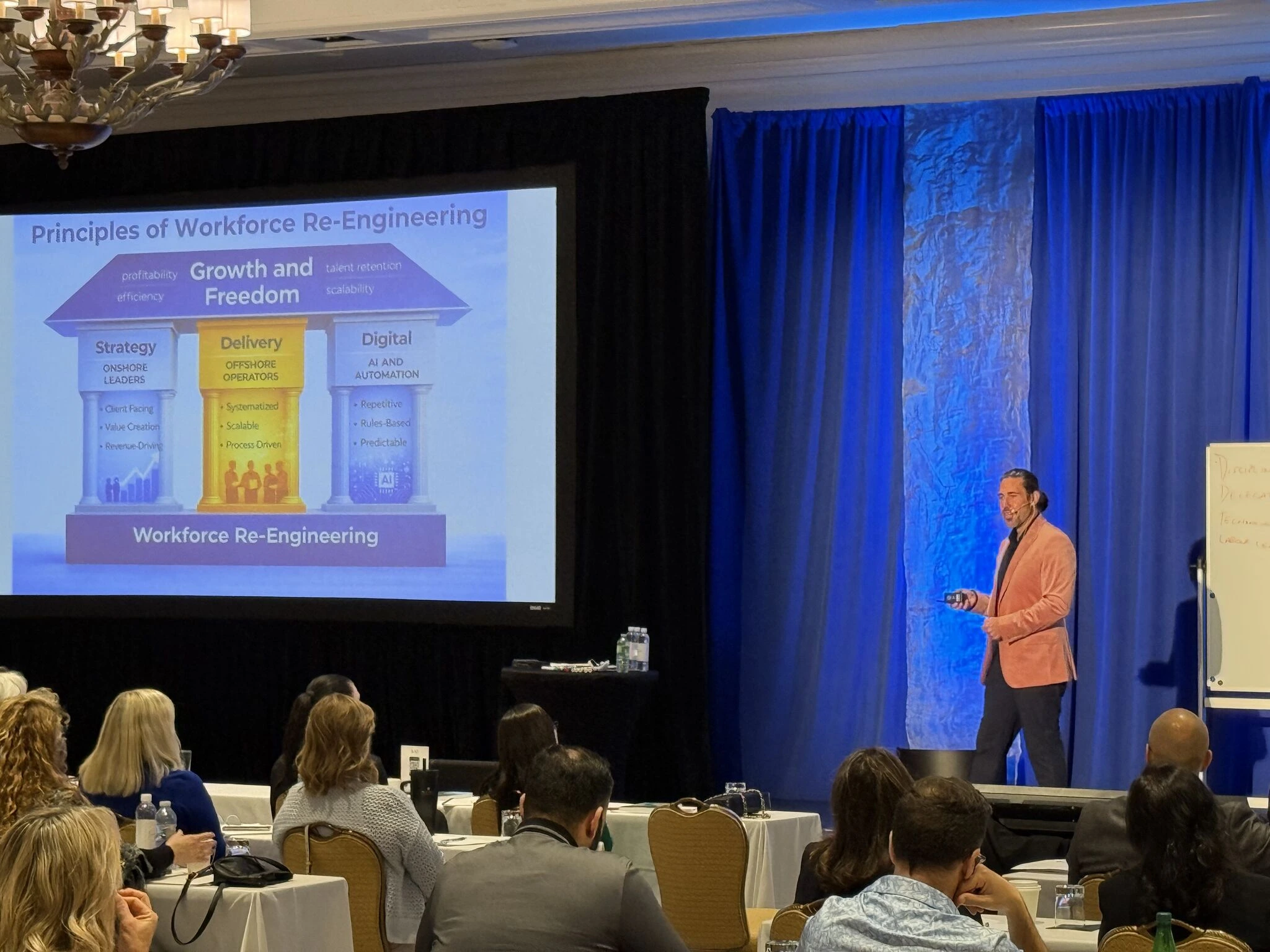
Anthony framed Workforce Re-Engineering around three pillars:
- Strategy for onshore leaders and client-facing experts
- Delivery for offshore teams managing systemised, scalable work
- Digital for AI and automation handling repetitive, rules-based tasks
This keeps advice, lender strategy and relationship management close to brokers, while repeatable work such as file preparation, CRM updates, follow-ups, reporting and marketing coordination has dedicated ownership.
PeoplePartners applies this as a full org chart workforce approach, designing dedicated teams around each client’s needs, culture and industry.
5. AI Does Not Fix Broken Execution

AI can improve speed, output and decision-making, but it can also amplify poor workflows, bottlenecks and overloaded roles.
Anthony distinguished between agentic AI, which supports repetitive execution, and AI-enhanced people, who use AI to improve communication, decisions and operational capability.
The right question is not how to replace people with AI. It is which work should be redesigned first, then supported by the right mix of people, global talent and automation.
How PeoplePartners Supports Mortgage Brokerage Workforce Re-Engineering
Anthony’s presentation closed with a practical model for how PeoplePartners helps brokerages redesign, build and support modern workforces.
The process has three stages:
1. Workforce Re-Engineer
This includes an organisational chart review, task audit, workforce design and Workforce Re-Engineering Report to identify how work flows and where high-value people are carrying low-value tasks.
2. Build
Once the work is clear, the brokerage can build the right mix of local talent, global talent and AI. Recruitment also becomes more precise because each role is designed around actual responsibilities, not a broad job title.
3. Employ and Support
PeoplePartners manages recruitment, onboarding, IT, payroll, HR, Philippine’s employment compliance and employee experience as the employer of record. The brokerage retains control of client advice, standards, tools, team direction and business decisions.
This model has supported 500+ organisations, 1,000+ global professionals, over $100 million in re-engineered labour and 100,000+ reallocated hours.
For the solo broker, the design flaw is usually an overloaded role.
The broker wants help, so they are looking for a “VA”. Then the list of tasks grows. Loan processing, credit analysis, diary management, invoices, email, webchat, website updates, SEO, blogs, marketing, video editing, social media and AI support all get pushed into one role.
The problem is not delegation itself. The problem is that one role is being asked to carry multiple skill sets.
The Workforce Re-Engineered solo broker model separated those tasks into sharper seats, including executive support, customer support, bookkeeping, creative marketing, technical marketing and development support. The point was not that every solo broker needs every role at once. The point was that the work must be separated before the hire is made.
For a Canadian mortgage brokerage, this means identifying the first real bottleneck. A Fulfilment Officer may be the right starting point when files are getting stuck. Past-client neglect may point to a Back Book Manager. Stronger documentation discipline may call for a Compliance Assistant under the brokerage’s direction.
Common Mortgage Support Roles to Consider
Anthony’s presentation listed common mortgage support roles across client support, loan processing, business operations and marketing. For Canadian mortgage brokerages, the most relevant support seats may include:
- Fulfilment Officer: supports file movement, document collection, milestone tracking and process follow-through
- Back Book Manager: supports client check-ins, database ownership, renewal activity and post-settlement relationship activity
- Compliance Assistant: supports documentation, file completeness and process administration under the brokerage’s direction
- Executive Assistant: supports diary management, inbox coordination and internal organisation
- Marketing Coordinator: supports campaign coordination, content scheduling and social media administration
- Operations Coordinator: supports recurring internal coordination and process follow-up
The title matters less than the design of the seat. A role works when the task mix is clear, handoffs are defined and the team knows what success looks like.
Watch Anthony Rice’s CMBA webinar here:
Build the Brokerage Before the Pressure Peaks
The brokerages best positioned for sustainable growth will redesign how work gets done, rather than simply adding more people to the same structure. This means protecting broker time for advice, lender strategy and client relationships, while assigning repeatable operational work to clearly defined support roles and using AI where it creates genuine value.
PeoplePartners is a workforce re-engineering and global staffing partner helping mortgage brokerages and other growing businesses across Australia, the United States, Canada and New Zealand design, build and support dedicated offshore teams.
Through organisational design, task auditing and role development, PeoplePartners helps brokerage owners identify which responsibilities should remain onshore, move to global talent or be supported by AI and automation.
Once the right workforce structure is defined, PeoplePartners manages offshore recruitment, onboarding, IT, payroll, HR, Philippine employment compliance and ongoing employee support. Mortgage brokerages retain control of their clients, systems, service standards, team direction and business decisions.
Contact PeoplePartners today to explore how we can help your mortgage brokerage improve capacity, strengthen operations and build a more scalable support model.
Frequently Asked Questions (FAQs)
Workforce Re-Engineering for mortgage brokerages is the redesign of roles, processes and team structures inside a brokerage. It identifies where work is sitting today, separates high-value and low-value tasks, and builds clearer roles around the work that needs to be done.
Hiring a virtual assistant starts with a person. Workforce Re-Engineering starts with the work. It defines what should stay with the broker, what should move to support and which role should own each task before recruitment begins.
Offshore support can carry repeatable, process-led tasks such as document follow-up, file preparation support, CRM updates, client service coordination, settlement coordination, back book activity and marketing production support.
AI can support drafting, summarising, sorting and first-pass analysis. It does not replace role ownership. Brokerages still need people to manage context, exceptions, process quality and accountability.
A future-ready brokerage has clear role ownership, protected broker time and a structure that can handle growth without relying on overloaded principals, brokers or support staff.
