Scaling an EOS-run business is meant to bring clarity and control. With defined Visionary and Integrator roles, a structured Accountability Chart, and a system built for execution, growth should feel more predictable over time.
But for many EOS-run businesses, it doesn’t.
As the business grows, things often start to feel heavier instead of easier. Execution slows down, roles expand beyond their original scope, and leaders find themselves pulled back into the day-to-day. Even with the right framework in place, something begins to break at scale.
At some point, it raises a more difficult question. If EOS is working, why does scaling still feel this hard?
Why EOS Businesses Struggle to Scale Efficiently

Most EOS businesses aren’t struggling because of a lack of discipline. In fact, many are running strong Level 10 meetings, tracking scorecards, and maintaining accountability across the business. The challenge is what happens as complexity builds.
As teams grow, roles tend to stretch to accommodate more responsibilities. Work begins to overlap, ownership becomes less clear, and what once felt simple starts to feel fragmented. Over time, this creates friction across execution, even if the structure still looks sound on paper.
The natural response is to act quickly. Leaders hire more people, delegate more aggressively, or introduce new tools to improve efficiency. But these responses often address the symptoms rather than the underlying issue. The problem isn’t just capacity. It’s how the work is structured.
Why Hiring Isn’t Fixing the Problem
Hiring is often the first move when pressure builds. It’s visible, immediate, and gives the impression that more capacity will solve the issue.
But in many EOS businesses, hiring doesn’t lead to better execution. Instead, it introduces another layer of complexity.
New hires frequently step into roles that are too broad or not clearly defined. Responsibilities overlap, accountability becomes harder to track, and onboarding takes longer than expected. Rather than simplifying operations, hiring can unintentionally make coordination more difficult.
This is why some businesses continue to grow headcount without seeing a meaningful improvement in output.
The issue isn’t the people being hired. It’s the structure they’re stepping into.
The Hidden Constraint: How Work Is Structured
In growing EOS businesses, inefficiencies rarely come from a lack of effort. More often, they come from how work is distributed across the team.
High-value roles are pulled into low-value tasks. Leaders stay involved in execution. Specialists take on responsibilities that don’t align with their core function. Over time, this creates a mismatch between role design and actual workload.
On paper, the Accountability Chart may look complete and well-organised. In reality, roles can be too broad, misaligned with workflows, or overloaded with competing priorities.
When that happens, execution slows, decision-making becomes harder, and scaling requires more effort than it should.
What Workforce Re-Engineering Means for EOS Businesses

Workforce re-engineering is about redesigning how work flows through the business so that structure supports execution.
It’s not about adding more people. It’s about ensuring the right work sits in the right roles.
This means separating high-value work from low-value tasks, narrowing roles so they are easier to hire and train, and aligning responsibilities into clear, repeatable functions. Instead of relying on “do-it-all” roles, businesses move toward more focused positions that are easier to manage and scale.
When structure improves, the rest of the system becomes more effective. Accountability becomes clearer, delegation starts to work as intended, and output becomes more predictable.
To see how this applies in practice, visit:
https://peoplepartnersbpo.com/what-we-do/workforce-reengineering/
Where EOS Businesses Are Getting It Wrong
The issue isn’t the work itself. It’s who is doing the work.
Many EOS businesses rely on roles that combine administrative, operational, and technical responsibilities into a single seat. While this may work in the early stages, it becomes increasingly difficult to sustain as the business grows. These roles are harder to hire for, take longer to onboard, and often lead to burnout.
At the same time, high-cost roles are frequently handling low-value tasks. Leaders and specialists spend time on coordination, scheduling, and admin instead of focusing on higher-impact work.
There’s also the issue of fragmented ownership. When work is spread across multiple people without clear accountability, it leads to delays, rework, and inefficiencies that compound over time.
The Impact of Getting the Structure Right
When workforce structure is aligned with how work actually happens, the difference is noticeable.
Roles become easier to hire for because expectations are clear. Onboarding becomes faster because responsibilities are better defined. Teams operate with more consistency, and leaders are able to step out of the day-to-day to focus on growth.
Efficiency improves not because people are working harder, but because the structure supports the way work needs to be done.
In many cases, businesses see meaningful improvements in productivity and cost efficiency simply by redesigning how roles are structured.
Why This Matters Now
EOS businesses are operating in a more demanding environment than ever. Talent is harder to find, costs continue to rise, and expectations around growth remain high.
At the same time, efficiency has become a key differentiator.
Businesses are no longer evaluated solely on how fast they grow. They are also judged on how effectively they operate. This makes workforce structure a strategic advantage rather than just an operational detail.
Those that take the time to improve how their teams are designed will outperform those that continue to rely on hiring alone.
See Where Your Margins Are Actually Stuck

At the 2026 EOS Conference, PeoplePartners is introducing a practical way to assess how your current structure is performing.
It’s called MarginScore.
MarginScore provides a fast way to evaluate your Accountability Chart and identify where inefficiencies may exist. By uploading your org chart, you can quickly see where profit may be trapped in your workforce and where there is potential to improve margins.
At the PeoplePartners booth, attendees can run their MarginScore, review the results, and gain a clearer understanding of how their structure is impacting performance. Those who complete the assessment can also enter to get a chance to win a $500 Amazon gift card.
Anthony Rice at the 2026 EOS Conference

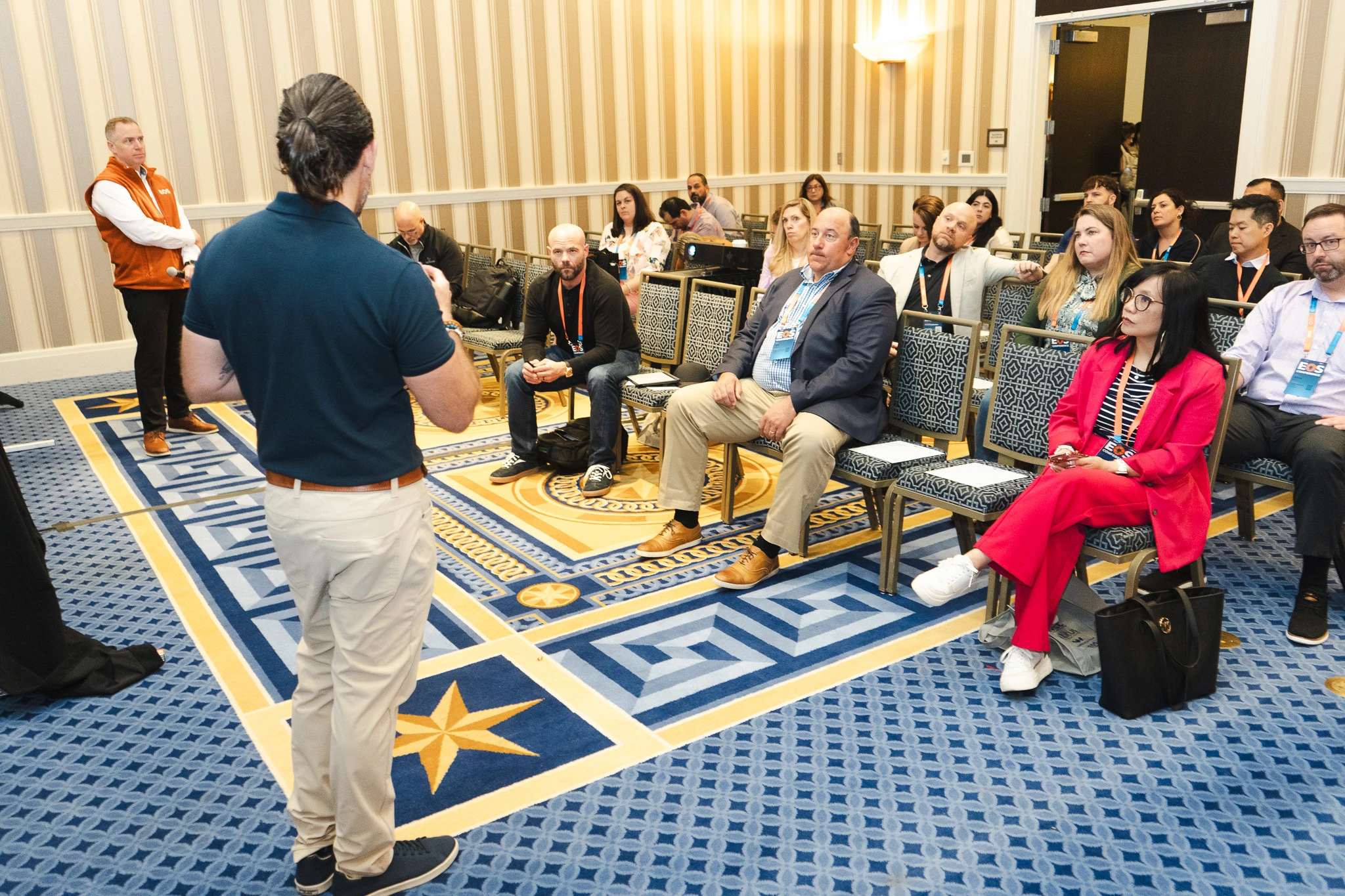
At this year’s EOS Conference, Anthony Rice will be part of Breakout Session 3, contributing to a discussion that focuses on what really happens inside scaling EOS businesses.
For many leaders, the challenge isn’t understanding EOS. It’s maintaining execution as the business grows. As roles expand and teams evolve, the gap between structure and how work actually gets done becomes more apparent.
This session addresses that gap directly.
It explores why execution often slows at scale, where inefficiencies tend to sit within the Accountability Chart, and how hiring and delegation decisions can unintentionally add complexity instead of reducing it. Rather than introducing another layer of process, the discussion focuses on how better role design and clearer alignment can improve execution without increasing headcount.
Session Details
You’re Optimizing the Wrong Thing—and Delegate and Elevate® Can’t Fix It
Breakout Session 3
📅 April 22, 2026
🕓 4:00–5:00 PM
📍 Kansas City Convention Center
Anthony Rice is the Co-Founder of PeoplePartners, helping EOS-run businesses achieve profitable, scalable growth by re-engineering Accountability Charts. His work focuses on helping leaders delegate and elevate more effectively by aligning roles and leveraging global talent to improve execution.
Learn more:
https://peoplepartnersbpo.com/who-we-are/anthony-rice/
Meet the Team at the ENRG™ Mixer

Beyond the sessions, EOS is built on community.
PeoplePartners will be attending the 3rd Annual ENRG™ Mixer at EOS Conference® 2026, happening on Thursday, April 23. ENRG™ brings together entrepreneurs and organisations running on EOS, creating space for connection, shared learning, and meaningful conversations.
Anthony Rice and Reuben Brennan will both be attending. If you’re there, it’s an opportunity to connect and continue the conversation in a more informal setting.
How PeoplePartners Supports EOS Businesses

PeoplePartners works with EOS-run businesses to improve how their teams are structured and scaled. This includes workforce re-engineering, access to global talent, and aligning roles based on how work actually gets done.
The focus is not just on filling roles, but on building a structure that supports long-term growth.
Explore how this applies to EOS businesses:
https://peoplepartnersbpo.com/industries/eos-outsourcing/
You can also explore more insights here:
https://peoplepartnersbpo.com/blog/
