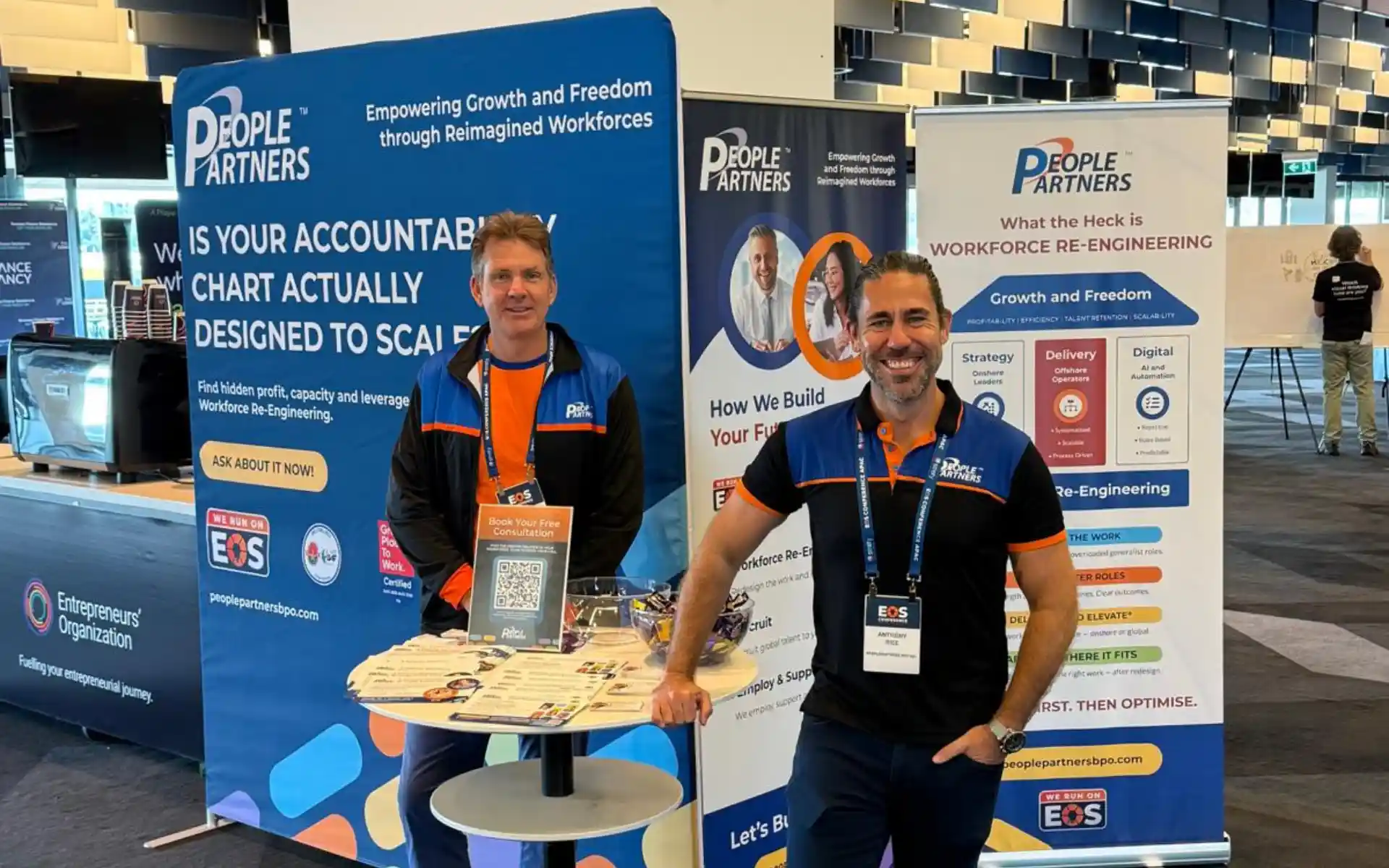
EOS Conference® APAC 2026 gave EOS run-businesses a useful moment to step back and look at what happens after The Accountability Chart® is clear, the meeting rhythm is running, and the team is still feeling pressure. The Sydney event was built for companies running on EOS, with practical sessions, EOS rollout support, and networking for more than 600 EOS-driven leaders.
At the event, Anthony Rice, Co-Founder of PeoplePartners and Global Workforce Educator, brought a clear workforce design message to the room. Anthony as a workforce effectiveness speaker helps growing companies break through bottlenecks by rethinking how their teams are structured.
The core takeaway was direct: when pressure appears, leaders often try to optimise discipline, delegation, technology, or labour leverage. Those moves can help, but they all assume the structure is already sound. The sharper question is this: what if the role is wrong?
Key Takeaways:
- Pressure usually appears where a role is overloaded, unclear, or carrying the wrong mix of work.
- Delegation, technology, and labour leverage work best after the business redesigns the work.
- AI can accelerate execution, but it also exposes bottlenecks, fragmented workflows, and poor operating design.
- Workforce Re-Engineering gives EOS-run businesses a practical path: re-engineer the workforce, build the right mix of talent, then employ and support that workforce.
- The next step is to review where execution is overloaded before adding another tool, role, or process.
Takeaway 1: Pressure is a signal that the role may be wrong
When a business leader feels pressure, the first instinct is often to push harder.
The team adds another meeting. A leader delegates more tasks. The business tries new software. A founder looks for offshore support. Each move can be logical, but Anthony’s presentation made one point clear: discipline, delegation, technology, and labour leverage are force multipliers. They cannot be added into chaos without amplifying the existing inefficiency.
That is a useful lens for EOS-run businesses. A company may have the right rhythm, the right scorecard, and the right meeting structure, but still have overloaded seats. The operations leader might still own too much coordination. The founder might still sit in approvals, follow-ups, and internal triage. The customer support leader might still carry reporting, ticket review, and knowledge base updates.
Those are not always people problems. Often, they are role-design problems.
A better question is:
- Which seats feel heavier than they should? Which roles depend too much on one person’s memory?
- Which leaders are still doing coordination work below their seat?
- Which workflows keep returning to the founder?
- Which tasks should be redesigned before another hire is added?
That is where Workforce Re-Engineering starts.
Takeaway 2: Delegation only works when work has somewhere clear to go
Delegate and Elevate™ is useful because it helps leaders see what they should stop carrying. But delegation becomes difficult when the next owner is unclear.
A founder may know they should stop doing admin, but admin is not one task. It may include inbox triage, meeting follow-up, CRM hygiene, reporting prep, file organisation, research, and scheduling. An operations leader may know they should stop chasing updates, but those updates may be tied to unclear handovers, missing review rules, or weak task ownership.
That is why delegation alone can feel frustrating. The leader hands off work, but still explains the same thing every week. They review every output. They answer the same questions. They stay the final point of coordination.
Workforce Re-Engineering turns delegation into a clearer work-design process. It separates:
- Work leaders should keep.
- Work support can prepare.
- Work that can move into offshore ownership.
- Work that needs redesign before anyone else owns it.
- Work that may be suited to client-owned AI support, once rules and review steps are clear.
PeoplePartners has written about this same issue in AI vs Offshore Talent: What to Automate, What to Delegate, and What to Keep Human. That article explains why the real decision is not AI versus people. The stronger question is which type of work belongs with which layer of the workforce.
Takeaway 3: AI does not fix broken execution
One of the strongest ideas from the presentation was that AI does not fix broken execution. It exposes it.
AI is a force multiplier that can amplify speed, output, communication, decision-making, and execution, but it can also amplify chaos, bottlenecks, overloaded roles, fragmented workflows, and poor operating design.
That is the risk for businesses using AI too early in the wrong place. AI can draft faster, summarise faster, classify faster, and produce first-pass work faster. But if no one owns the workflow, speed will not create accountability. If review rules are unclear, faster output creates faster rework. If the task is sitting in the wrong seat, AI only helps the wrong person move faster.
This is the better sequence:
- Identify where execution is overloaded.
- Audit the work sitting inside that pressure point.
- Decide which work needs leadership judgement.
- Decide which work can be supported by AI, offshore talent, or both.
- Build the role or workflow around clear ownership.
That keeps AI in the right place. It becomes a support layer, not the operating model itself.

Takeaway 4: Labour leverage needs workforce design first
Offshore support can create capacity, but only when the role is designed around real work.
Hiring offshore staff into an unclear role usually creates more coordination for the local team. The founder still explains what matters. The manager still checks every detail. The offshore team member stays busy, but the seat owner remains the hub.
That is why PeoplePartners does not frame offshore staffing as a generic hiring shortcut. The presentation outlined a three-part path:
- Workforce Re-Engineer – Identify overloaded roles, execution bottlenecks, and workforce design opportunities.
- Build – Build the workforce using the right mix of local talent, global talent, and AI-enabled execution.
- Employ and Support –Recruit, employ, and support the workforce.
For EOS-run businesses, this matters because the Accountability Chart® shows who owns the seat, but it does not always show the work sitting under the seat. That work needs to be reviewed before the business hires again.
Explore PeoplePartners’ Workforce Re-Engineering process for the role design side, or visit EOS Outsourcing to see how this applies to businesses running on EOS.
Takeaway 5: The next move is a workforce pressure test
The presentation closed with a practical next step: use a Workforce Design Pressure-Test to identify where execution is overloaded, where labour spend is misaligned, where AI and global talent could create leverage, and where hidden profit may sit inside the current structure.
Turn the workforce pressure test into a practical next step
| Pressure-test question | What to look for | Best next step |
|---|---|---|
| Where is execution overloaded? | Seats where the same person owns decisions, coordination, follow-up, reporting, and admin. | Start the task audit with the seat carrying the most pressure. |
| Where is labour spend misaligned? | High-value people carrying recurring work that does not need their judgement. | Identify work that could move into a clearly designed support role. |
| Where is the workflow fragmented? | Tasks with unclear triggers, handovers, review rules, owners, or escalation points. | Use Workforce Re-Engineering before hiring. |
| Where could global talent create leverage? | Repeatable work that needs ownership, follow-through, system updates, coordination, or reporting preparation. | Build Your Team of dedicated offshore support. |
| Where could AI support the first pass? | Rules-based work where the business already has clear inputs, repeatable steps, and review standards. | Use client-owned AI support where appropriate, then keep human review for exceptions and judgement. |
| Which role needs redesign before hiring? | Roles where the job title is clear, but the work, outputs, handovers, or review rules are not. | Redesign the workflow first, then decide whether local talent, offshore talent, or AI support fits best. |
The Workforce Design Pressure-Test gives EOS-run leaders a way to move from reflection into practical diagnosis. Instead of leaving EOS Conference® APAC 2026 with ideas only, use the pressure test to find where execution is overloaded, where labour spend is misaligned, where AI and global talent could create leverage, and where hidden profit may sit inside the current structure.
Watch the complete 3-part YouTube series and learn more how to redesign work, build the right talent mix, and create a workforce that scales.
Review Your Workforce Design With PeoplePartners

If EOS Conference® APAC 2026 raised questions about your current team structure, start with the work.
Book a call with PeoplePartners. We will review where execution is overloaded, where low-value tasks are sitting with high-value people, and where offshore talent or AI-enabled execution could create better capacity.
PeoplePartners helps EOS-run businesses build dedicated offshore teams through Workforce Re-Engineering, Zero Bench Recruiting, Transparent Salary, and ongoing Employer of Record support.
Get started without paying anything upfront. Stay because it works, not because you’re locked in. If it’s not the right fit, we’ll find a replacement at no extra cost.
Frequently Asked Questions (FAQs)
Workforce Re-Engineering helps EOS-run businesses review where execution is overloaded, where labour spend may be misaligned, and where low-value tasks are sitting with high-value people. From there, the business can redesign roles around the right mix of local talent, offshore talent, and AI-enabled execution. The goal is a cleaner structure before the business adds more people or tools.
Workforce Re-Engineering reviews the work before it is handed over. It identifies which tasks should stay with local leaders, which should move to support roles, which can be handled offshore, and which need clearer process design first.
No. AI can support execution, but it can also expose messy workflows, unclear ownership, and overloaded roles. Workforce design helps leaders decide where AI belongs and where human judgement still needs to sit.
Offshore talent can support better workforce design when the role is built around clear, transferable work. That may include operations support, finance support, administration, customer service, marketing support, or other dedicated functions. PeoplePartners uses Zero Bench Recruiting to access talent precisely matched for you, rather than treating offshore hiring as a generic handover of leftover tasks.
PeoplePartners helps businesses review their current workforce structure, identify low-value tasks, and design dedicated offshore roles around the work that should move. Through Workforce Re-Engineering, Zero Bench Recruiting, Transparent Salary, and Employer of Record support, PeoplePartners helps build dedicated offshore teams that fit the client’s needs, culture, and operating structure.
