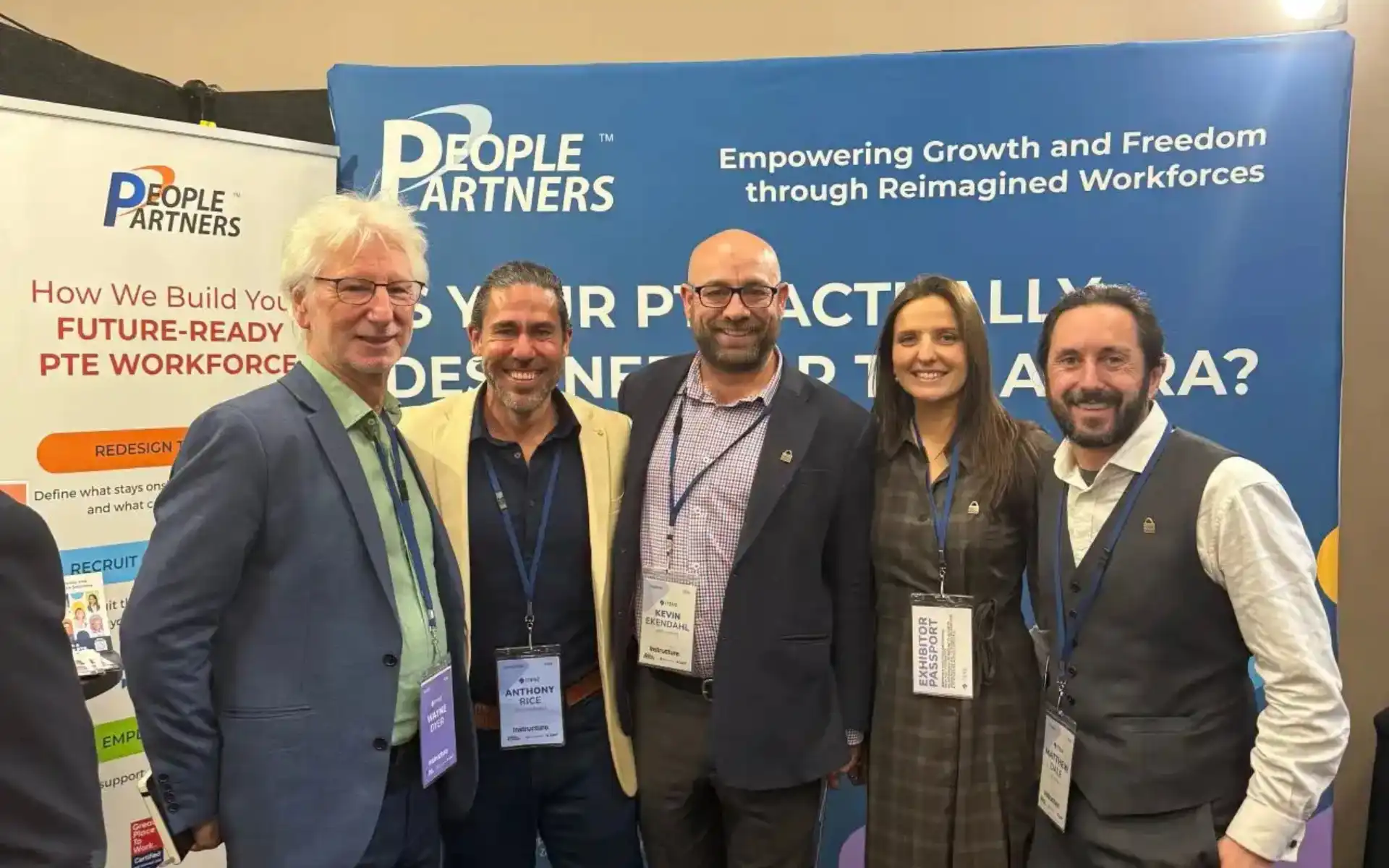
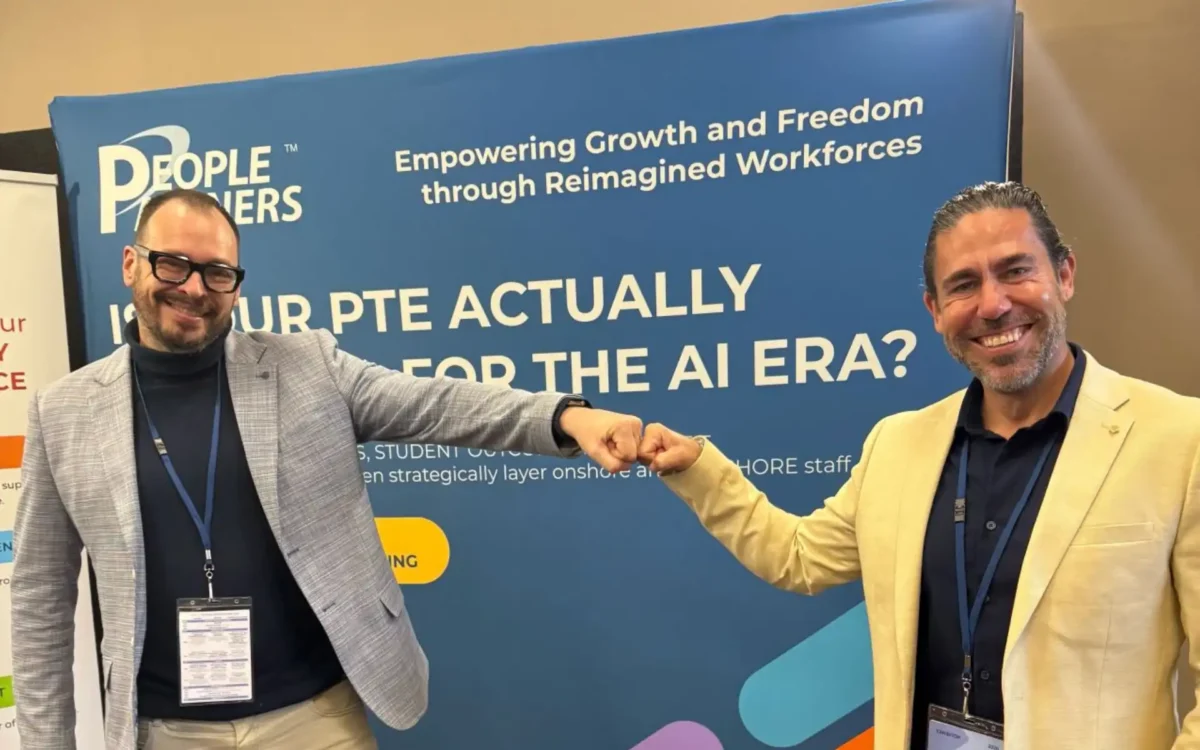
At ITENZ Conference 2026, Anthony Rice, Co-Founder of PeoplePartners, inspired PTE leaders to rethink what they are really trying to optimise. Building on the conference theme, Responsive Education and Training: From Policy to Practice, his breakout session, “Workforce Design for the AI Era: Why You’re Optimising the Wrong Thing,” challenged conventional thinking about workforce planning in an AI-driven world.
Key takeaways:
- Common fixes can miss the real issue: Discipline, delegation, technology, and labour leverage all fall short when the role itself is poorly designed.
- Segmentation beats duplication: Adding another broad role can grow the org chart, while clearer task clusters make work easier to onboard, lead, and scale.
- Overloaded roles need redesign: Where PTE Leaders should start when work feels too heavy.
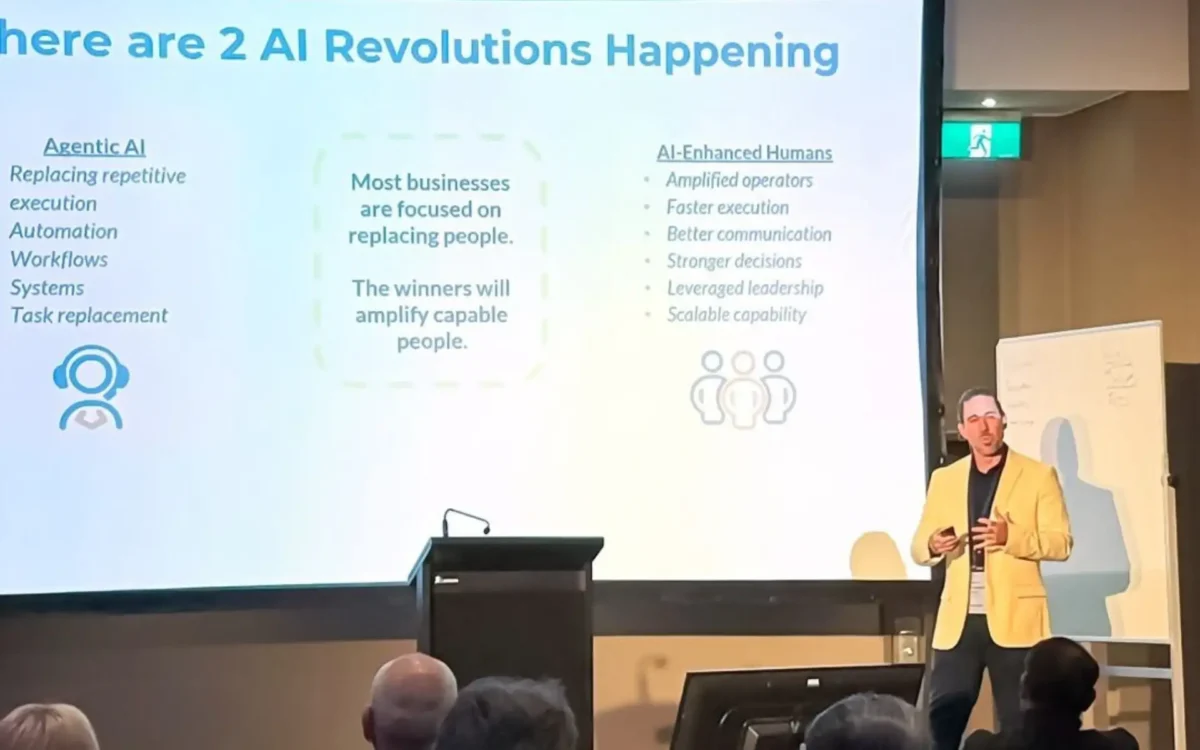
- AI is reshaping work in two ways: automating repetitive tasks through agentic AI and amplifying human capability through AI-enhanced workers.
- Workforce design should come before global talent and AI, so dedicated offshore support is built around clear, well-scoped work.
The Four Responses: Why Common Fixes Assume the Role Is Right
One of the presentation’s most thought-provoking topics showed four common responses leaders reach for when pressure builds: discipline, delegation, technology, and labour leverage.
The point was not that these responses are wrong. The issue is that each one assumes the role underneath is already right.
| Common Fixes That Assume the Role Is Right | |
|---|---|
| Response | What it assumes |
| Discipline | The role is already right. |
| Delegation | The role is already right. |
| Technology | The role is already right. |
| Labour leverage | The role is already right. |
| Key point: Accountability does not equal capacity. You cannot delegate chaos. | |
| Before adding more pressure, tools, or people, ask: what if the role is wrong? | |
Anthony’s challenge was to ask a more useful question: what if the role itself is wrong? A role may look like it needs better accountability, another system, or another person. But if the role combines too many types of work, too many handovers, or too many decision layers, the fix may need to start with design.
That is the foundation of Workforce Re-Engineering: redesigning execution layers so roles become narrower, aligned, and transferable.
Duplication vs. Segmentation: Understanding the Root Cause of Org Chart Bloat
Duplication happens when organisations add another generalist, another coordinator, or another assistant into a structure that is already overloaded. The org chart grows, but the work may still be unclear.
Segmentation works differently. It splits work into aligned task clusters, narrows roles so they become easier to onboard and lead, and reduces cognitive overload from constant context switching. That is the practical foundation behind Workforce Re-Engineering: redesigning how work moves before adding more people or tools.
This distinction is especially relevant for education providers because PTE teams often carry mixed execution layers. One person may be expected to handle student queries, scheduling, reporting, evidence collection, internal coordination, and administration follow-up in the same seat.
When that happens, adding another broad role can create temporary relief without solving the operating problem. Segmentation gives leaders a more practical way to decide which work should stay together, which work should be separated, and which work can move into a clearer support layer.
Harvard Business School’s Working Knowledge also discusses how job design depends on the complexity and interdependence of the work, which supports the same principle: roles need to be designed around how work actually gets done. Read the HBS article on job design.
Where PTE Leaders Should Start When Work Feels Too Heavy
Anthony’s presentation gave PTE leaders two practical starting points for spotting a workforce design problem: review the org chart, then audit the tasks sitting inside overloaded roles.
This connects directly to Workforce Re-Engineering, which helps leaders redesign how work moves before adding more people, tools, AI, or offshore support. For PTEs, that means looking at the work first, then deciding which tasks should stay local and which could sit in a clearer support layer through PeoplePartners PTE support.
| Two Checks for Spotting a Workforce Design Problem | ||
|---|---|---|
| Starting point | What to look for | Why it matters |
| Organisational chart review | Roles that are hard to hire for, have high attrition, take too long to onboard, combine technical and administrative work, or create rework. | These roles may need redesign before PTEs add more people, tools, or pressure. |
| Task audit | Work that can be split into aligned task clusters, narrowed into repeatable roles, or simplified to reduce context switching. | Clearer roles are easier to train, lead, support, and scale through a better-designed operating model. |
| Key point: redesign the work before deciding what should stay local, move into offshore support, or be supported by AI. | ||
For a related PeoplePartners read, the article Offshore Staffing Companies for Role Design explains why hiring from the title alone can place capable people into unclear roles, which is exactly the kind of issue a task audit can help prevent.
The Two AI Revolutions: Replacement and Amplification
Two AI revolutions are happening at once: agentic AI and AI-enhanced humans. The first focuses on replacing repetitive execution through automation, workflows, systems, and task replacement. The second enables capable people to execute faster, communicate more effectively, make stronger decisions, and scale their leadership capacity.
Agentic AI may help with repeatable work, but it still needs clean inputs, clear ownership, and defined review points. AI-enhanced humans need the same thing. A capable operator can only use AI well when the role has clear boundaries, the handovers are documented, and the work is not buried inside an overloaded seat.
This is why Workforce Re-Engineering comes before AI adoption. Redesigning the work first helps leaders decide what should stay with local owners, what can move into a clearer support layer, and where AI can support execution without creating more confusion.
The same theme is showing up in broader workplace research. Microsoft’s Work Trend Index on agents and human agency frames the next phase of work around AI agents taking on execution while human agency expands. McKinsey’s article on the agentic organisation also describes agentic teams as human teams that own and supervise AI workflows.
That supports Anthony’s point: the stronger AI opportunity is not just replacing repetitive tasks. It is redesigning work so the right people, roles, AI tools, and support layers can operate together. For further insights from PeoplePartners, see AI vs Offshore Talent .
How PeoplePartners Helps PTEs Turn Workforce Design Into Better Support Roles
| Support Roles PTEs Can Consider After a Task Audit | |||
|---|---|---|---|
| Work area | Relevant team | Example roles | Best fit |
| Recurring administration | Administration Support team | Administrative Assistant | Routine admin, inbox support, data entry, and coordination tasks. |
| Scheduling and coordination | Operations team | Program Coordinator | Program updates, scheduling support, workflow coordination, and stakeholder follow-up. |
| Document handling | Operations team | Document Controller | Document organisation, file control, version tracking, and evidence preparation support. |
| Trainer and program support | Operations team | Trainer Support Specialist | Training schedules, learner communication, document updates, and coordination support. |
| Student or stakeholder communication | Customer Service team | Customer Service Representative | Structured student queries, stakeholder updates, ticket handling, and communication follow-up. |
| CRM and reporting support | Sales team or Operations team | CRM Specialist or Data Analyst | CRM hygiene, reporting preparation, data updates, and operational reporting support. |
| Key point: choose the role after the task audit, not before it. | |||
Redesign Your PTE Support Model
ITENZ Conference 2026 made the workforce design question clear: before PTEs add more people, tools, AI, or offshore support, they need to understand how the work is currently structured. Broad roles, unclear handovers, and overloaded execution layers can make growth harder than it needs to be.
PeoplePartners helps PTEs look at the work first, then shape dedicated offshore support roles around clearer task clusters. That means your local team can stay focused on judgement, relationships, sensitive decisions, and provider-owned review while recurring work sits in roles that are easier to train, lead, and scale.
Frequently Asked Questions (FAQs)
Workforce Re-Engineering for PTEs means redesigning overloaded execution layers across student administration, enrolments, trainer scheduling, evidence collection, audit preparation, reporting, and student queries so work is grouped into clearer, narrower roles that are easier to onboard, lead, and scale.
Common fixes such as discipline, delegation, technology, and labour leverage can fall short when they assume the role is already right, instead of checking whether the role itself needs redesign.
PTE leaders can start with an organisational chart review and task audit, looking for roles that are hard to hire for, have high attrition, take too long to onboard, combine technical and administrative work, or create frustration, rework, and double handling.
The two AI revolutions are agentic AI, which focuses on replacing repetitive execution through automation, workflows, systems, and task replacement, and AI-enhanced humans, where capable operators use AI to improve execution, communication, decisions, leadership, and scalable capability.
AI can amplify speed, output, communication, decision-making, and execution, but it can also amplify chaos, bottlenecks, overloaded roles, fragmented workflows, and poor operating design, so the work needs to be redesigned first.
Need a Trusted Offshoring Partner? Let’s Talk!
Tell us how we can support your business, and we’ll get back to you shortly.